
Oil‑Less vs. Oil Turkey Fryer: Which Is Worth It?
An oil-less fryer is safer but cooks more like a fast roaster. Real fried turkey takes 3 gallons of oil. Who should buy which, and who should skip both.
As an Amazon Associate I earn from qualifying purchases.
In this guide
He followed the box to the letter. The turkey still came out pink.
One r/grilling user loaded a 13.5 lb turkey into a Char-Broil Big Easy, the best-known oil-less turkey fryer. It was a calm 60-degree day. He preheated for 15 minutes on a full propane tank and went by the "10 min a pound" rule. The included thermometer read 160–165°F, so he pulled it and let it rest. The thighs and bottom half were still pink. He was "disappointed because i thought i followed directions to a T."1
He's not alone, and that tells you what an oil-less fryer really is. Here's how it compares with the real thing, and which one (if any) belongs on your patio this Thanksgiving.
Plot twist: an oil-less fryer doesn't fry
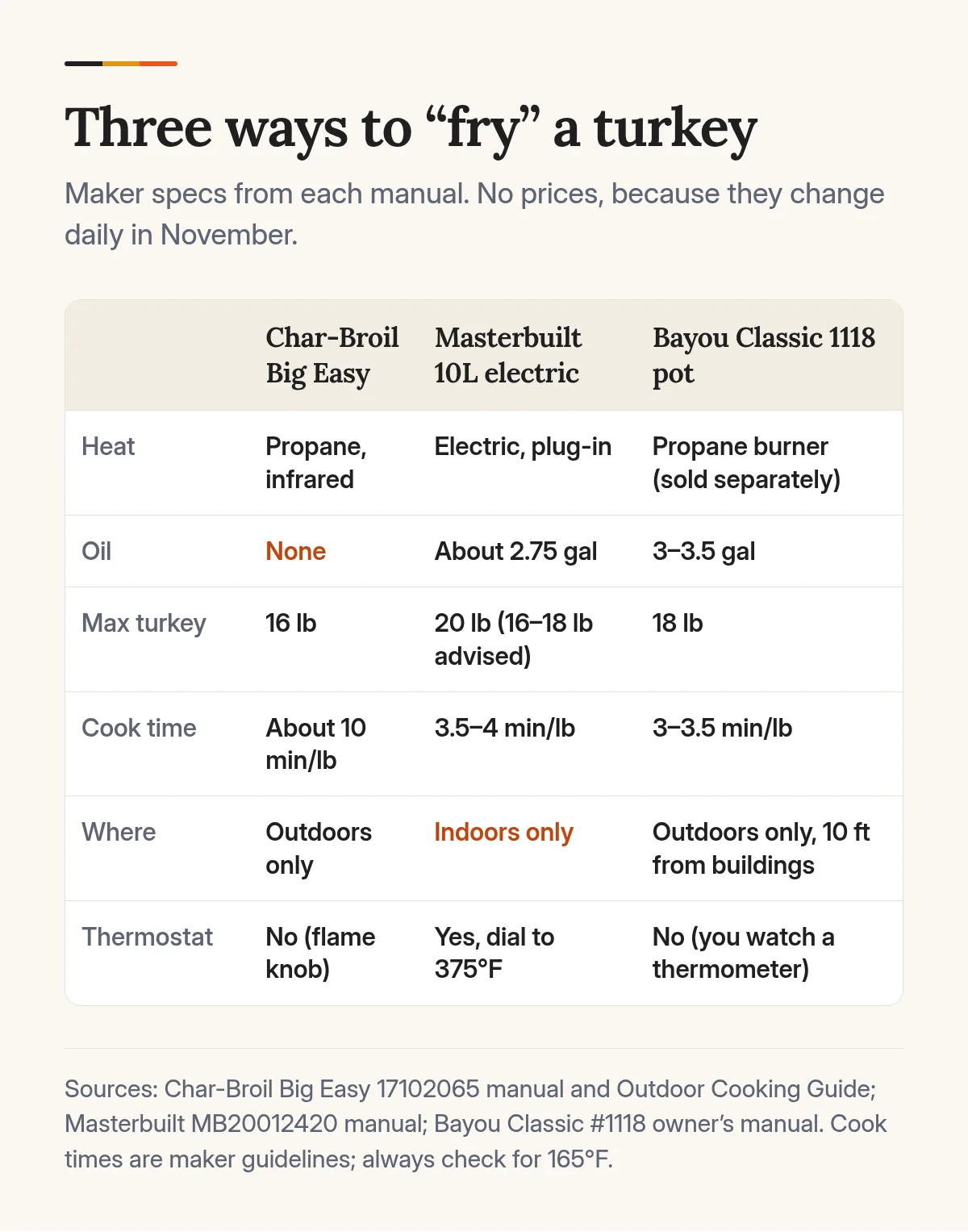
The Big Easy is a propane burner that heats a metal drum, which radiates heat onto the bird. It's an outdoor roaster with a basket. Char-Broil's own cooking guide suggests about 10 minutes per pound for turkey. An oil fryer takes about 3 minutes per pound.
Char-Broil's argument is that oil eats the difference back. Up to 3 gallons can take 45 minutes to heat and hours to cool before cleanup. It says the whole oil-frying process takes twice as long.
Owners mostly love the result. One Amazon reviewer said they "will never go back to deep frying our thanksgiving turkey in oil again."2 One r/thanksgiving user's husband has cooked their turkey in a Big Easy for five years.3 But another reviewer was blunt: it "just doesn't have the flavor or crispiness as a traditional oil turkey fryer."4 Crisp, juicy roast turkey? Yes. The crackly, fried-chicken skin of a deep-fried bird? Not quite.
The real problem: breast done, thighs raw
The pink-thigh story above is the most common complaint we found. Another r/grilling owner said the breasts hit 150°F "super fast" while the dark meat was "Like 120s." Twice the thighs were still unsafe when the bird came out. They ended up cutting it into portions and "baking it to safety."5 A third owner got a dry, overcooked bird one year and a raw middle the next, and was "about to get rid of the unit and go back to my oven."6
The fix is boring: ignore the clock. Treat 10 minutes per pound as the earliest check, not the finish line. Probe the thigh as well as the breast, and keep cooking until both reach 165°F. A leave-in probe thermometer plus an instant-read for spot checks makes this easy. Cold or windy day? The guide says to use the mesh lid, but not for the whole cook, or the outside can burn.
Fried with oil: incredible, and genuinely risky
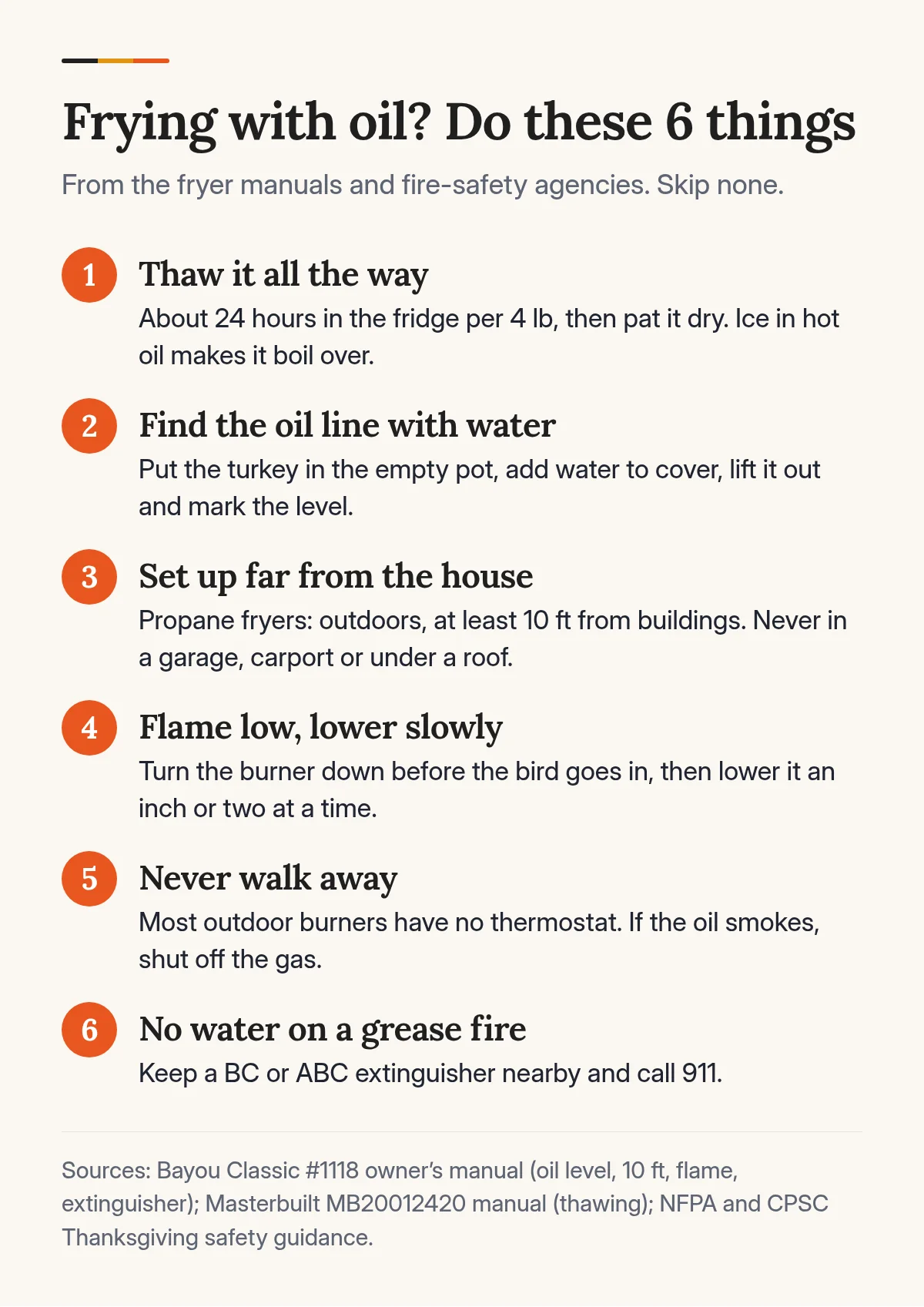
A propane pot of 350°F oil is a different animal. The National Fire Protection Association says turkey fryers that use oil "are not safe" and strongly discourages them. CPSC says it knows of 222 turkey-fryer fire or burn incidents since 1998, with 83 injuries and $9.7 million in property loss. And NFPA counts Thanksgiving as the peak day for home cooking fires: an estimated 1,139 reported in 2024.
Bayou Classic, which sells fryer pots, is surprisingly frank in its manual. It warns that a pot holding 3 gallons of oil that catches fire can throw a flame up to 15 feet high. Its burners have no thermostat, so you are the thermostat.
The counterintuitive pick: an oil fryer for indoors
Here's the twist almost nobody expects. The safer way to fry with real oil is inside the house. NFPA's own list of safer alternatives includes an "electric turkey fryer," alongside infrared and air fryers. The Masterbuilt manual goes further: "Do NOT use outdoors. Appliance is for indoor use only."
Why safer? A thermostat holds the oil at 375°F, a lid closes over the oil and the magnetic cord breaks away if someone trips on it. You still need about 2.75 gallons of oil, a level surface with 18 inches of clearance at the back and sides, and a wall outlet. The manual says no extension cord.
The trade-offs are real. The manual says preheating can take up to 45 minutes. Amazon's review summary flags oil that struggles to hold temperature. One owner called the result delicious but said it "doesn't fry to a crisp," with skin that tore away while slicing.7 Another's fryer "wouldn't turn on at all" on Thanksgiving.8 Run it once with water the week before.
Our picks
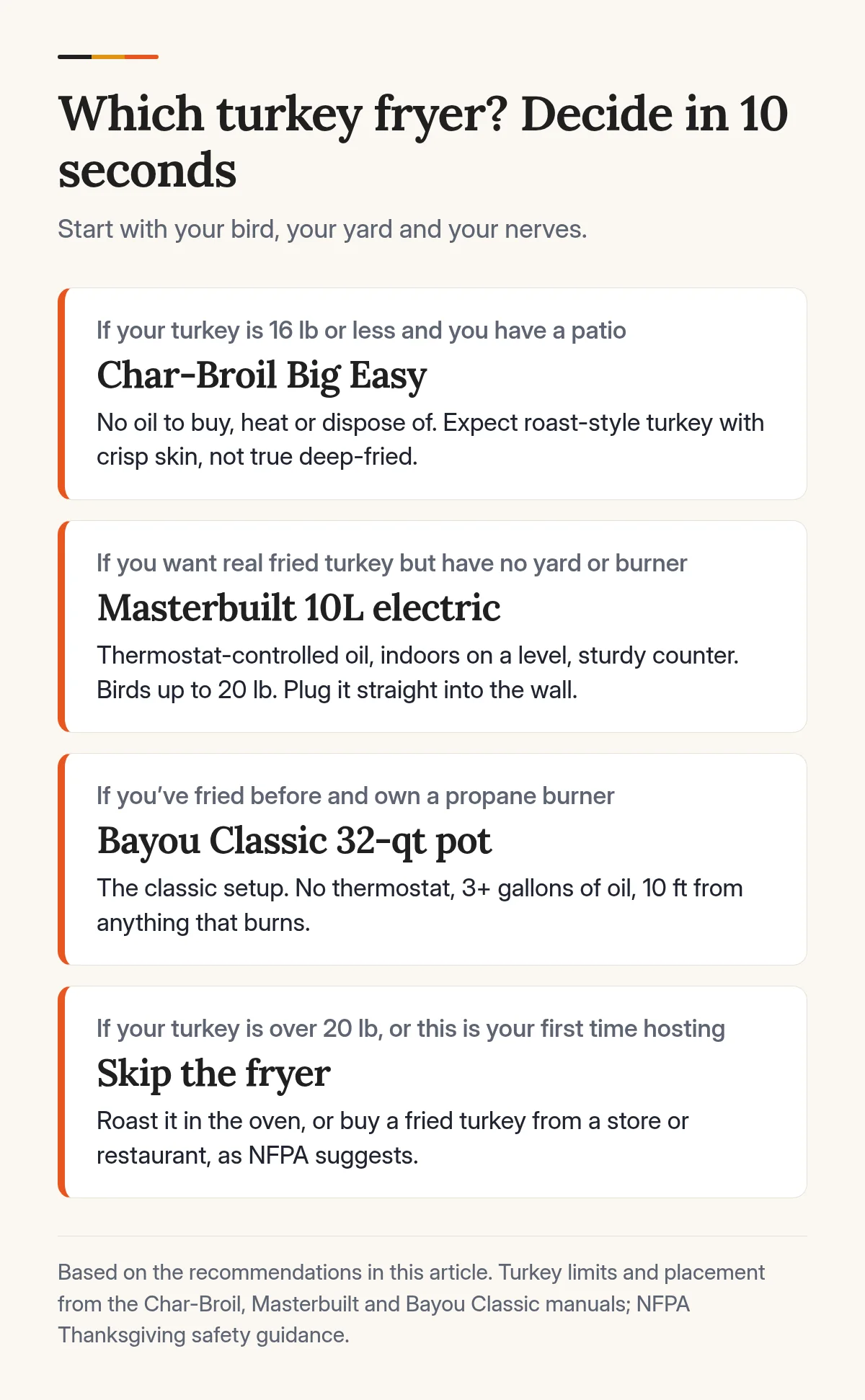
For most people: Char-Broil The Big Easy
The Big Easy oil-less fryer holds turkeys up to 16 lb on 16,000 BTU of propane, with a front grease tray and a 1-year limited warranty. The long-running 2017 version of this listing had 4.7 stars from more than 7,000 ratings when we checked. Its manual says outdoors only, at least 3 feet from walls and 10 feet from anything that can catch fire. One r/Cooking user borrowed a friend's Big Easy for a 20 lb bird and asked whether to squash it in.9 The answer is the label: 16 lb.
For real fried turkey: Masterbuilt 10L XL Electric Fryer
The Masterbuilt MB20012420 fries birds up to 20 lb (16–18 lb is what the maker recommends), and it also steams and boils. It had 4.6 stars from about 5,600 ratings when we checked. Stock has been thin, so don't wait.
Only if you know what you're doing: Bayou Classic 32-quart pot
The Bayou Classic 1118 is the stainless pot America's Test Kitchen picked as its winner, paired with a separate burner. It's rated for an 18 lb turkey and 3.5 gallons of oil max. Amazon's review summary mentions pinhole leaks for some owners, so inspect the bottom before every season.
If you fry with oil anyway
Don't buy a fryer if…
- Your turkey is over 20 lb. None of these fit it. Use a roasting pan, or an electric roaster if the oven is full.
- You only want it for one day a year and have no shed space. All three are bulky.
- You'll be juggling guests, kids and sides. Every manual here says never leave it unattended.
- You just want the flavor once. NFPA's own advice: buy a fried turkey from a store or restaurant.
Whichever way you cook it, let the bird rest, then carve on a board with a deep juice groove.
Who makes them
Char-Broil and Masterbuilt are the brands named on their listings and manuals. Bayou Classic makes the 1118 pot. None of the listings or manuals we checked says where the product is built, so we won't guess.
Owner stories are quoted from public posts and reviews and lightly trimmed. They are other people's experiences, not our own testing.
- “Big Easy suggested cooking time way off,” Nov 2024, r/grilling
- An Amazon customer review of the Char-Broil Big Easy
- “My husband has the Big Easy outdoor air-fryer…,” Nov 2025, r/thanksgiving
- Another Amazon customer review of the Char-Broil Big Easy
- “Charbroil Big Easy - Turkey Issues,” Nov 2024, r/grilling
- “Help with my Charbroil Big Easy!,” Oct 2025, r/grilling
- An Amazon customer review of the Masterbuilt 10L XL electric fryer
- Another Amazon customer review of the Masterbuilt 10L XL electric fryer
- “Cooking a 20 pound bird in The Big Easy,” Nov 2024, r/Cooking
Related guides
- Ninja Creami vs. Cuisinart: Which Ice Cream Maker?
- KitchenAid Pasta Attachment vs. Marcato: Worth It?
- Is Silpat Worth It Now That Its Maker Closed?
More in Cookware & Bakeware