
Is an Electric Roaster Worth It for Turkey?
Roasters free your oven and cook fast, but they steam instead of brown. Who should buy one, which size fits a 20 lb bird, and the 5-minute skin fix.
As an Amazon Associate I earn from qualifying purchases.
In this guide
The roaster had cooked the family turkey for years and years. Now it was the new host's turn.
One home cook inherited a Rival 18-quart roaster that had belonged to their husband's great-grandmother. Before trusting it with the turkey, they ran a test with a 5 lb chicken and a wireless probe. The dial went to 450°F. By the probe's reading, the air inside crept up to about 280°F and stopped there. The chicken was "SUPER juicy but the skin wasn't crispy at all."1
One reply summed up what every roaster owner learns eventually: "Roasters don't crisp the skin. The environment is very moist and steamy. Think of it similar to a giant crock pot."2
That's the deal. Here's whether it's a good one for you.
Plot twist: it's a steamer that happens to hold a turkey
A roaster is a deep metal tub with heating elements in the walls and a domed lid that drips moisture back onto the bird. That lid is why the meat comes out so juicy. It's also why the skin stays pale.
One owner who loves theirs summed it up: "Pop it in, never check, comes out so moist." The only downside? "Skin does not get crispy nor brown in most scenarios." Their fix: slice the bird in the kitchen and serve it in pieces.3
And don't trust the dial. Amazon's review summaries for both the AROMA and the Oster 18-quart mention temperatures that run hot or "way off." Your thermometer is the real control knob.
The 5-minute skin fix
- Dry and butter the skin before it goes in.
- Roast in the roaster on the rack, lid on, until the breast is almost done.
- Lift the bird out on its rack onto a sheet pan.
- Broil for a few minutes and watch it closely.
That's the move one owner uses: when the bird is done inside, a few minutes "in the oven/broiler or the grill, on high." With the oven full, a kitchen torch worked too.4 You only need the oven for those few minutes, not the whole afternoon.
It's faster than any chart says
The USDA says roaster times are "generally" the same as the oven: preheat to at least 325°F, keep the bird on a rack, and lift the lid as little as possible. But the Proctor Silex manual lists 2 to 3 hours for a 14–18 lb turkey at 325°F. The USDA's oven chart says 3¾ to 4¼ hours for that size, unstuffed.
Owners agree with the manual. One said an Oster does a 12 lb bird in "usually under 2 hours."5 Another trusted online recipes over the roaster's own chart. The turkey "was ready two hrs ahead of schedule and ended up drying out while we waited for people to show up."6
So start checking early, look for 165°F in the breast, thigh and wing, then hold it on the warm setting. A wired probe thermometer with the cable run under the lid saves you from lifting it.
Will your turkey fit? Don't trust the box
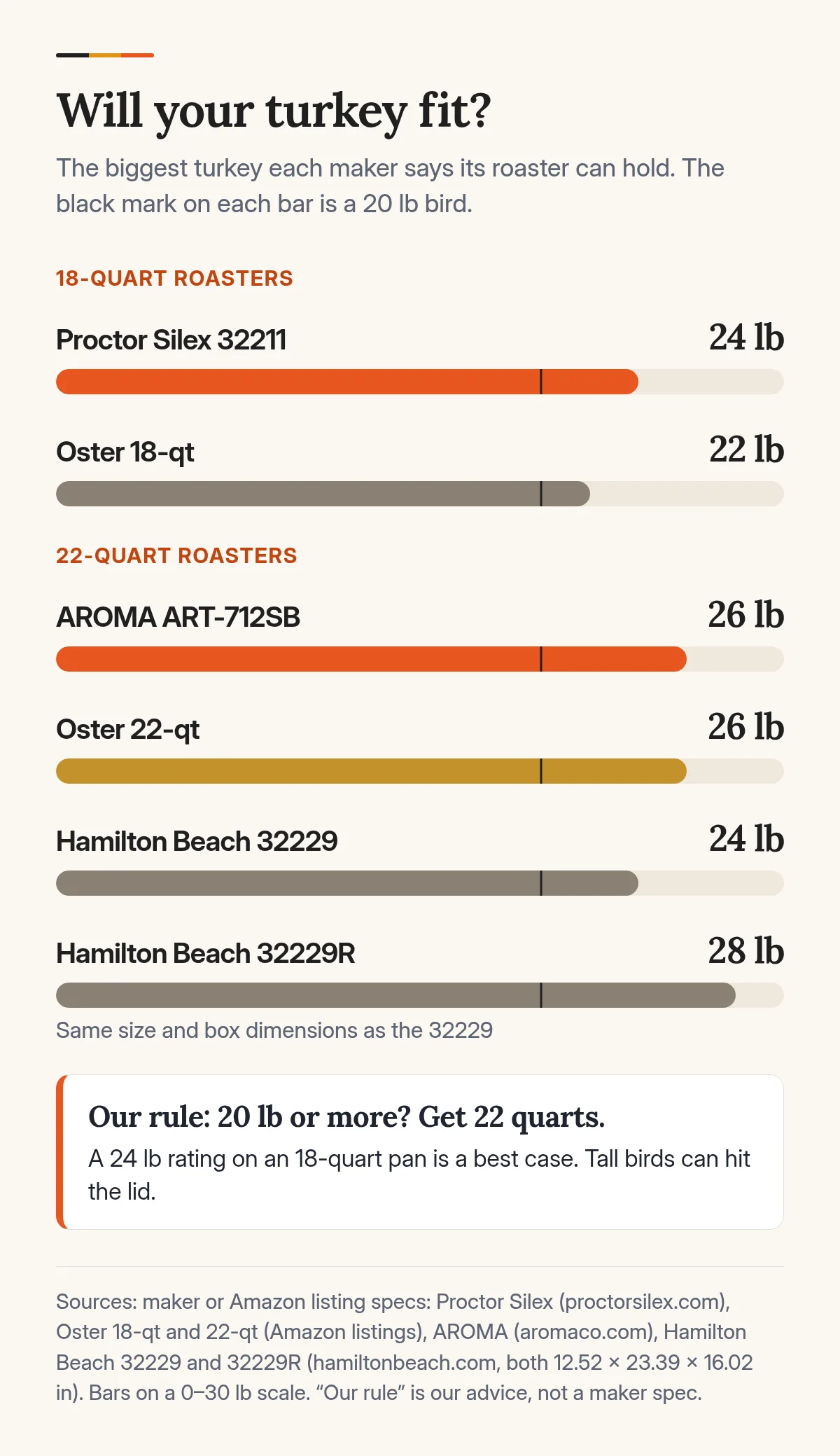
Hamilton Beach sold a 22-quart roaster rated for a 24 lb turkey. Its 32229R, with the exact same listed dimensions, was rated for 28 lb. The first one's fine print even warns that birds with "very tall or deep chest cavities might have difficulty fitting" under the lid (32229, 32229R).
It happens. One cook's mom had to tent the bird with foil "because the lid was hitting the top."7 The advice from a longtime Nesco owner: when you figure out the size you want, "buy the next size up from that."8
Our picks
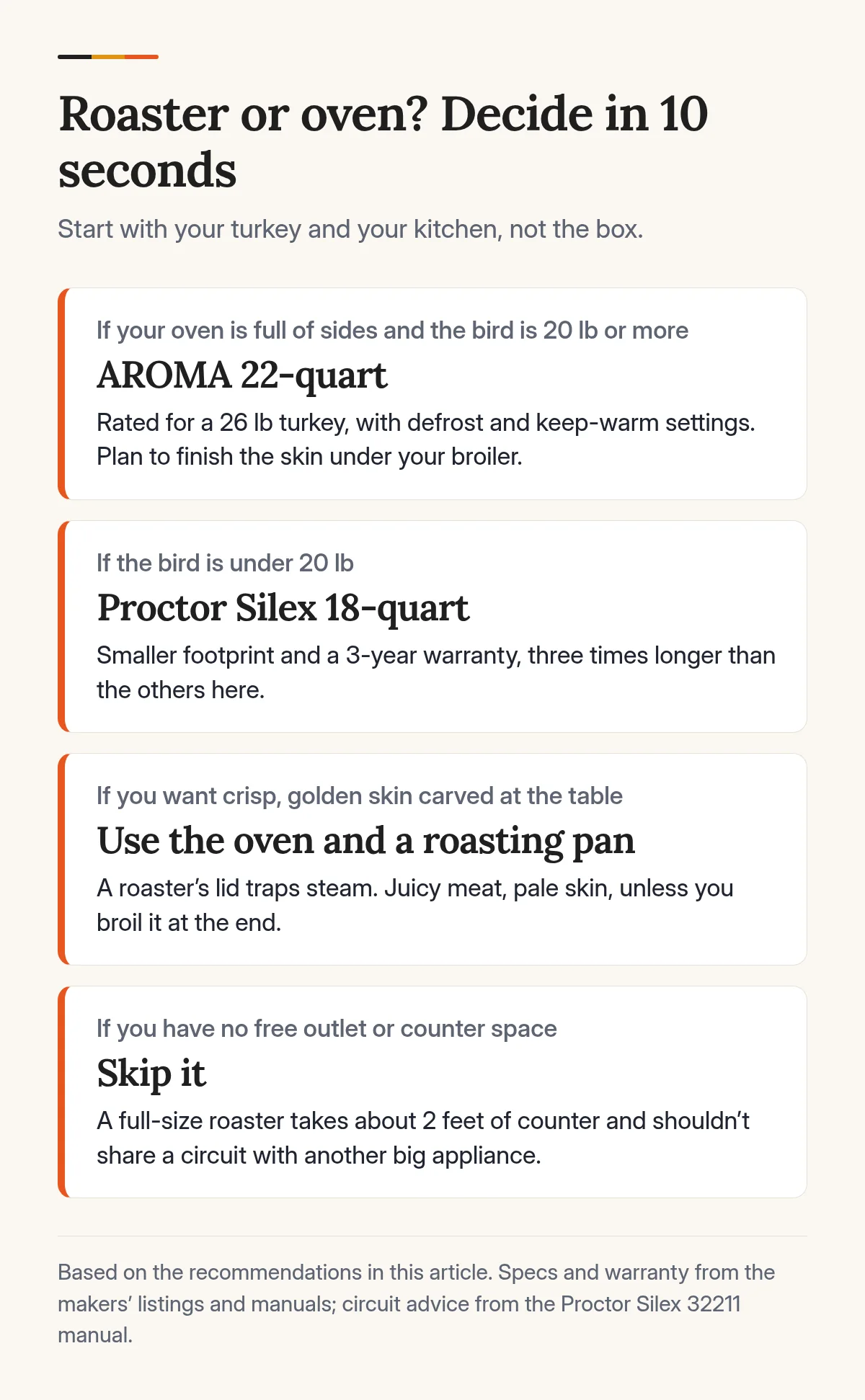
For a 20 lb+ bird: AROMA 22-quart
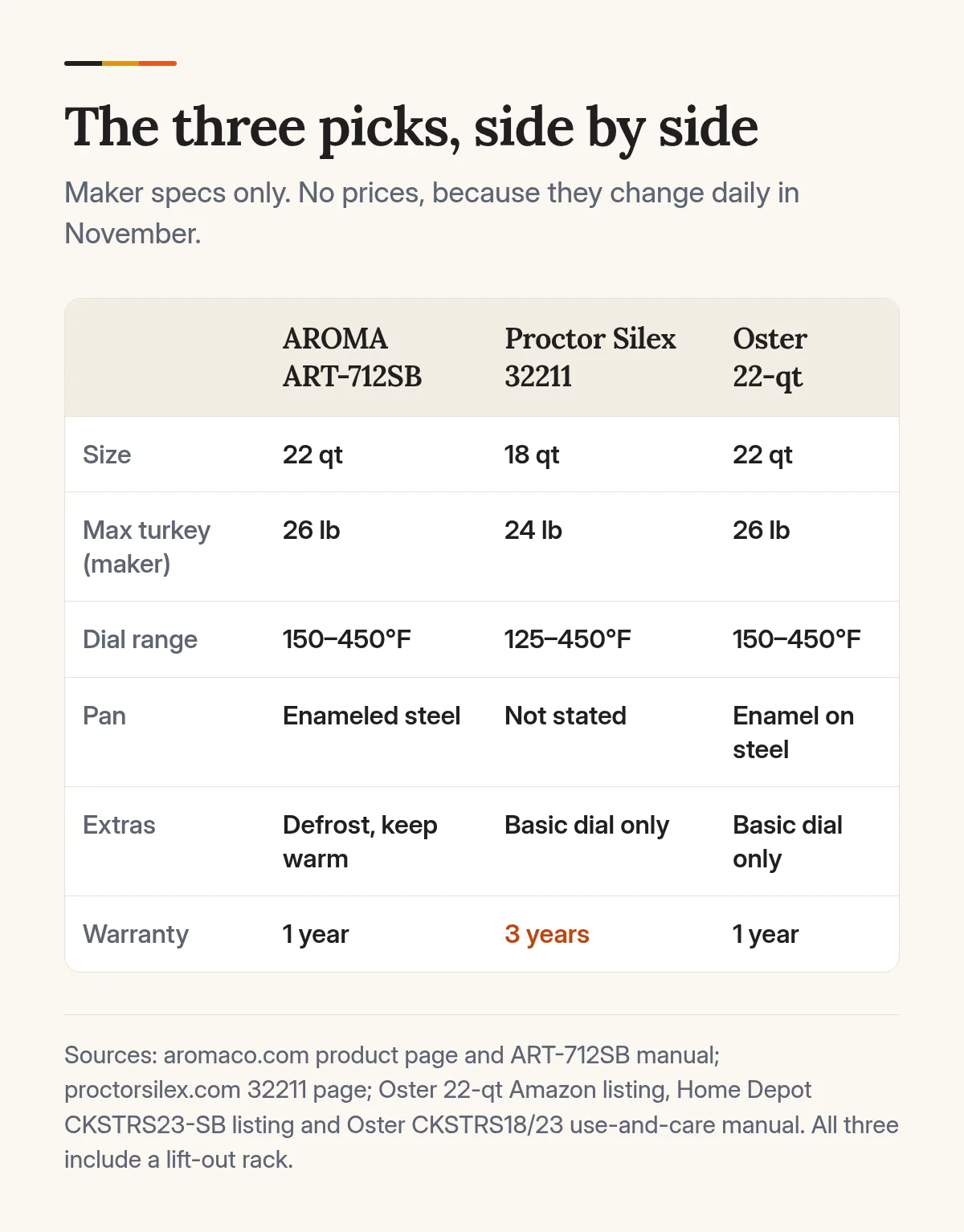
The AROMA ART-712SB is rated for a 26 lb turkey and adds defrost and keep-warm settings. When we checked, it had 4.5 stars from about 430 Amazon ratings. The catch: Amazon's review summary mentions a dial that runs hot, some dented pans and one dial that slid to high. One-year warranty.
For most families: Proctor Silex 18-quart
The Proctor Silex 32211 is a Hamilton Beach Brands roaster with a 125–450°F dial and a 3-year limited warranty, three times what the others offer. It's rated for 24 lb, but we'd keep it to 20 lb or less. It's a newer listing, at 4.6 stars from about 340 ratings when we checked.
The classic: Oster 22-quart
The Oster 22-quart has the longest track record: 4.6 stars from more than 14,000 ratings when we checked. It also has the most-documented flaws. Amazon's summary flags uneven heating for some owners and enamel that chips. Stock runs thin in November, so buy it only new, from Amazon or Oster.
Don't buy one if…
- Your oven is free. A 12–16 lb bird in a good roasting pan browns better and costs less.
- You want the carve-at-the-table moment. Pale skin photographs badly, even with a broiler finish.
- You're short on outlets. The AROMA, for one, draws 1,450 watts. The Proctor Silex manual says not to run another high-wattage appliance on the same circuit.
- You have nowhere to store it. All three are about 2 feet long.
Before the big day
- Run it empty once. Expect smoke and smell on the first heat-up. One Nesco owner wishes someone had said to burn it off first: "It gets stinky."9
- Preheat 15 minutes, lid on, per the Proctor Silex manual.
- Check your manual before using an oven bag. USDA says bags are fine if they don't touch the sides or lid, but Proctor Silex says skip plastic bags.
- Plan the landing. Rest the bird on a carving board with a juice groove, and check it with an instant-read thermometer first.
Who makes them
Proctor Silex belongs to Hamilton Beach Brands. AROMA is Aroma Housewares of San Diego. The Oster manual we found lists Sunbeam Products as the warrantor. None of the three listings we checked says where the roaster is built, so we won't guess.
Owner stories are quoted from public posts and lightly trimmed. They are other people's experiences, not our own testing.
- “Hoping to use an electric roaster from my great grandmother for Thanksgiving,” Nov 2025, r/Cooking
- A reply in the same thread, Nov 2025, r/Cooking
- A roaster owner's comment, Dec 2023, r/thanksgiving
- A reply, Nov 2025, r/Cooking
- An Oster owner's comment, Oct 2024, r/thanksgiving
- A comment from a four-Thanksgiving roaster user, Nov 2024, r/thanksgiving
- A comment, Dec 2024, r/thanksgiving
- A Nesco owner's comment, Dec 2023, r/thanksgiving
- A Nesco owner's comment, Oct 2024, r/thanksgiving
Related guides
- Ninja Creami vs. Cuisinart: Which Ice Cream Maker?
- KitchenAid Pasta Attachment vs. Marcato: Worth It?
- Is Silpat Worth It Now That Its Maker Closed?
More in Cookware & Bakeware