
Best Carving Board for Turkey: J.K. Adams vs Teakhaus (Do You Need a Juice Groove?)
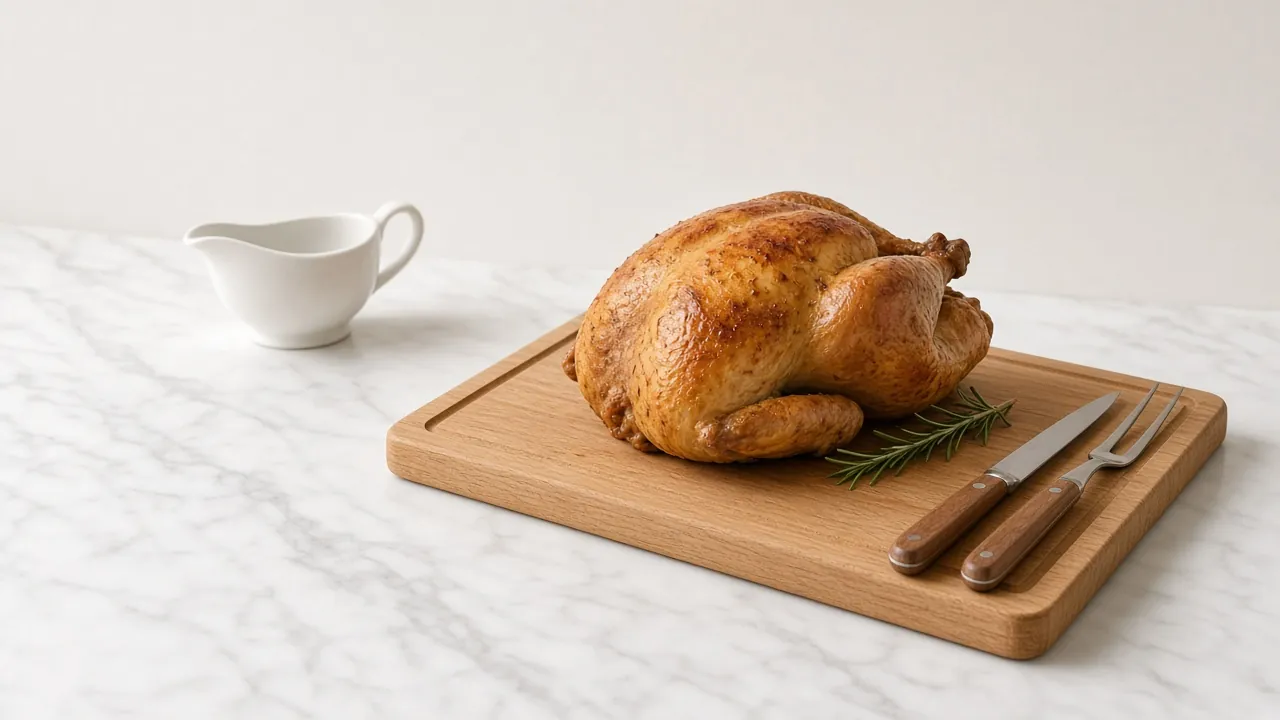
Turkey juice running off the board and onto the floor is a classic Thanksgiving mess. Here's which carving board actually holds it: the Vermont-made J.K. Adams or the big Teakhaus teak board, and when a regular cutting board is fine.
As an Amazon Associate I earn from qualifying purchases.
In this guide
The short version
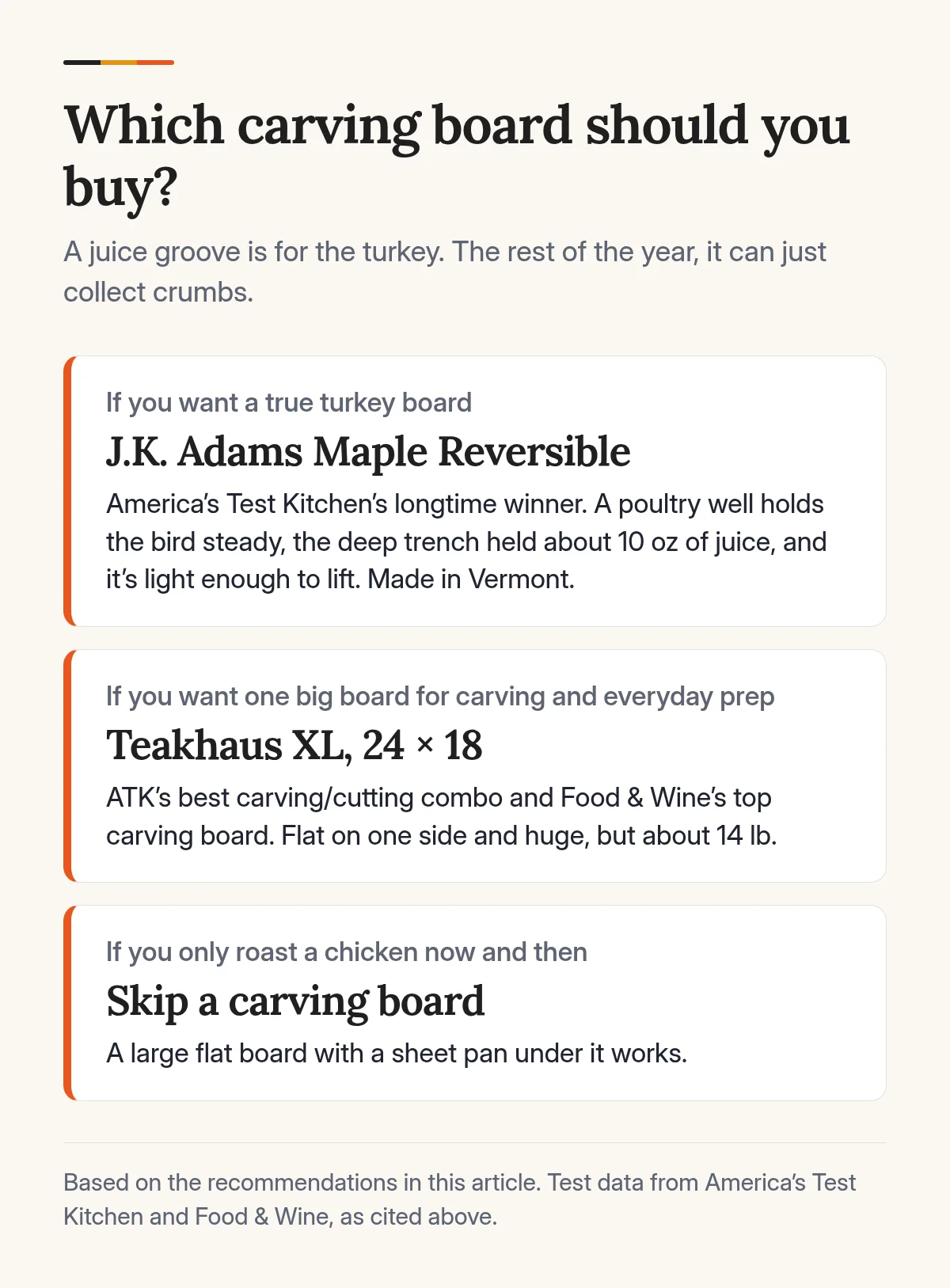
- You want a true turkey board → J.K. Adams Maple Reversible Carving Board. America's Test Kitchen's longtime winner. A poultry well holds the bird steady, the deep trench holds about 10 oz of juice, and it's light enough to lift. Made in Vermont.
- You want one big board for carving and everyday prep → Teakhaus Carving Board with Juice Canal (XL, 24 x 18). ATK's best carving/cutting combo and Food & Wine's top carving board. Flat on one side, huge, but about 14 lb.
- You only roast a chicken now and then? Skip it. A large flat board plus a sheet pan under it works.
The real problem: juice everywhere, and a bird that slides
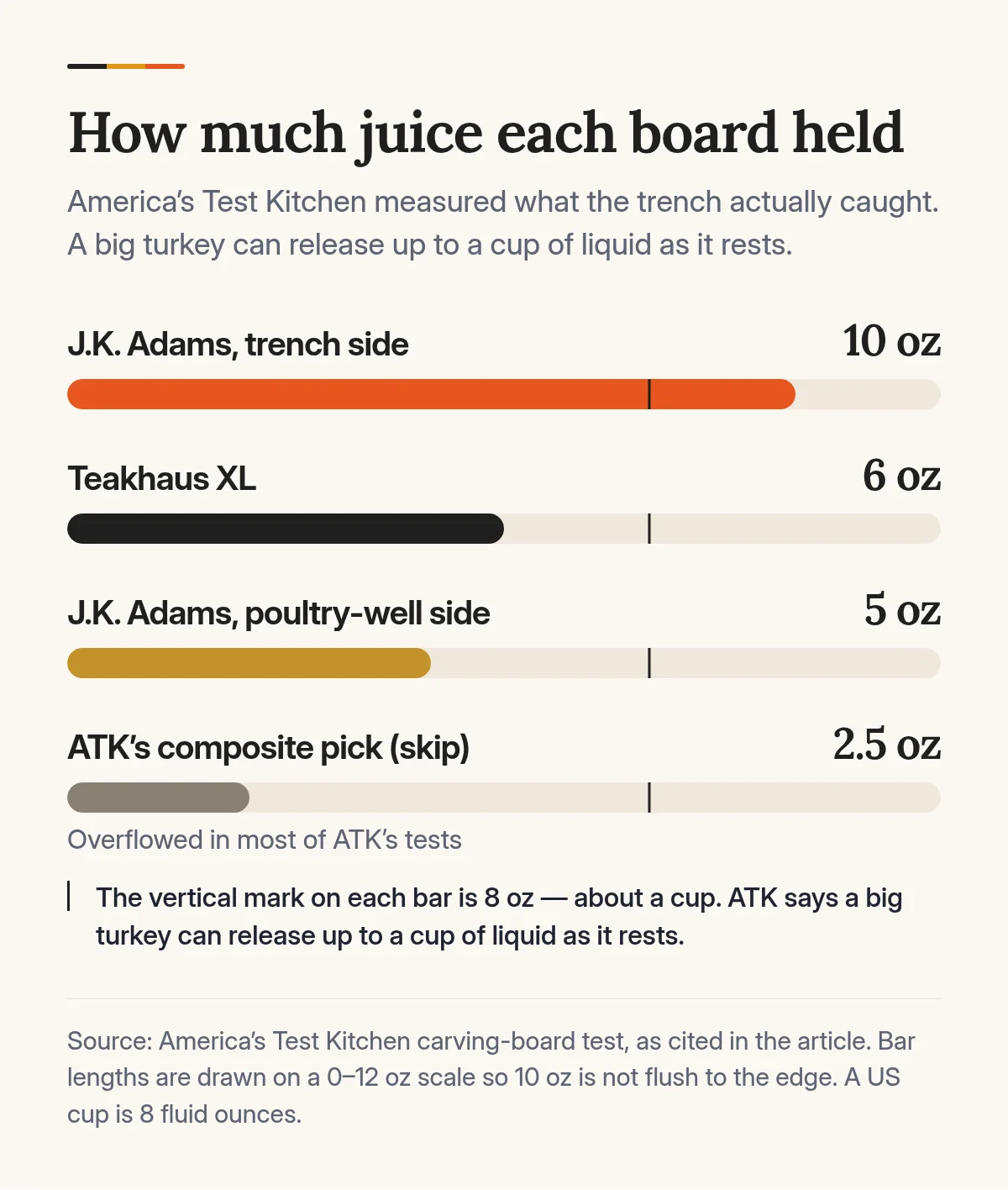
A big turkey can release up to a cup of liquid as it rests, according to America's Test Kitchen. On a flat cutting board, that runs over the edge, down the cabinet and onto the floor, right when the kitchen is full of guests. And a round, hot bird on a flat board wants to roll while you carve.
That's the job of a carving board: a deep trench to catch the juice (so it can go into the gravy) and enough size and weight to stay put. But Reddit cooks are right that grooves have a cost. On r/Cuttingboards, home cooks say a juice groove eats cutting space and turns into a "crumb collector" for everyday chopping. So the question is which board does the turkey job without being useless the other 364 days.
J.K. Adams vs Teakhaus at a glance
| J.K. Adams Reversible (TBS-2014) | Teakhaus XL with Juice Canal (108) | |
|---|---|---|
| Size | 20 x 14 x 1.25 in | 24 x 18 x 1.5 in |
| Weight (ATK) | 5.75 lb | 14.3 lb |
| Juice capacity (ATK) | 10 oz trench side, 5 oz poultry-well side | 6 oz |
| Other side | Poultry well to cradle the bird | Completely flat for daily prep |
| Wood | Maple | FSC-certified teak |
| America's Test Kitchen | Winner | Best carving/cutting board |
| Published origin | Dorset, Vermont, USA | Teak mainly from Latin America, made in Vietnam |
| Price tier | $$ | $$ |
Test data from America's Test Kitchen and Food & Wine. Origin from J.K. Adams and the Teakhaus FAQ. Check current prices at the retailer.
Why the J.K. Adams is the turkey board to buy
ATK calls the J.K. Adams Maple Reversible Carving Board its "longtime favorite." The trench on its flat side held 10 ounces in testing, more than half a cup, and the other side has a shallow poultry well that cradled a 20-pound turkey without getting in the knife's way. At under 6 pounds it's easy to carry to the sink, or to the table with the bird on it.
The trade-off is size. At 20 x 14 inches it handles a big turkey, but the flat cutting area inside the groove is about 15.6 x 10.25 inches, so it's not a great everyday chopping board. One Amazon reviewer returned a first board for small cracks at a glue seam and got a quick replacement; J.K. Adams backs it with a lifetime guarantee. Like any maple board, it needs oil now and then, and it's hand-wash only.
When the Teakhaus is the smarter buy
If you'd rather own one big board than two, the Teakhaus Carving Board with Juice Canal (XL) is the pick. ATK says it's nearly identical to its favorite everyday wood cutting board, with a flat side for daily prep and a trench side for carving, and it's "large enough to handle the biggest roasts, briskets, and turkeys." Food & Wine ranked it first out of about two dozen boards and saw no spillage while cutting up a whole chicken.
Two catches. It weighs about 14 pounds, so you'll move the turkey to a platter instead of carrying the board. And its trench held 6 ounces in ATK's test, less than the J.K. Adams, so for a very juicy 20-pounder, tilt the bird and spoon juice into the gravy as you go. Teak's natural oils mean less upkeep than maple; Food & Wine noted a woody smell that fades with use and didn't transfer to food.
What to skip
- Spikes and pyramids. ATK found textured surfaces made slicing harder and risked knife damage. On r/AskCulinary, one owner of a spiked board said it "never gets used."
- Tray-style boards with raised sides. The juice has nowhere to go, so the roast sits in a puddle and the skin goes soggy (ATK).
- Thin plastic or composite carving boards. Their trenches are too shallow. ATK's composite pick held just 2.5 oz and overflowed in most tests.
- Anything smaller than about 20 x 15 inches if you roast a big turkey. That's ATK's minimum for a large bird with room to work.
Where they're made
- J.K. Adams. A Vermont woodshop on Route 30 in Dorset for more than 80 years. The company lists this board as made in the USA from North American hardwood, finished in its own mineral oil and beeswax.
- Teakhaus. Its FAQ says the FSC-certified teak comes mainly from Latin America and is made into boards at its facility in Vietnam, which it describes as one of the biggest clusters of premium tropical-wood manufacturers.
Carve without the mess
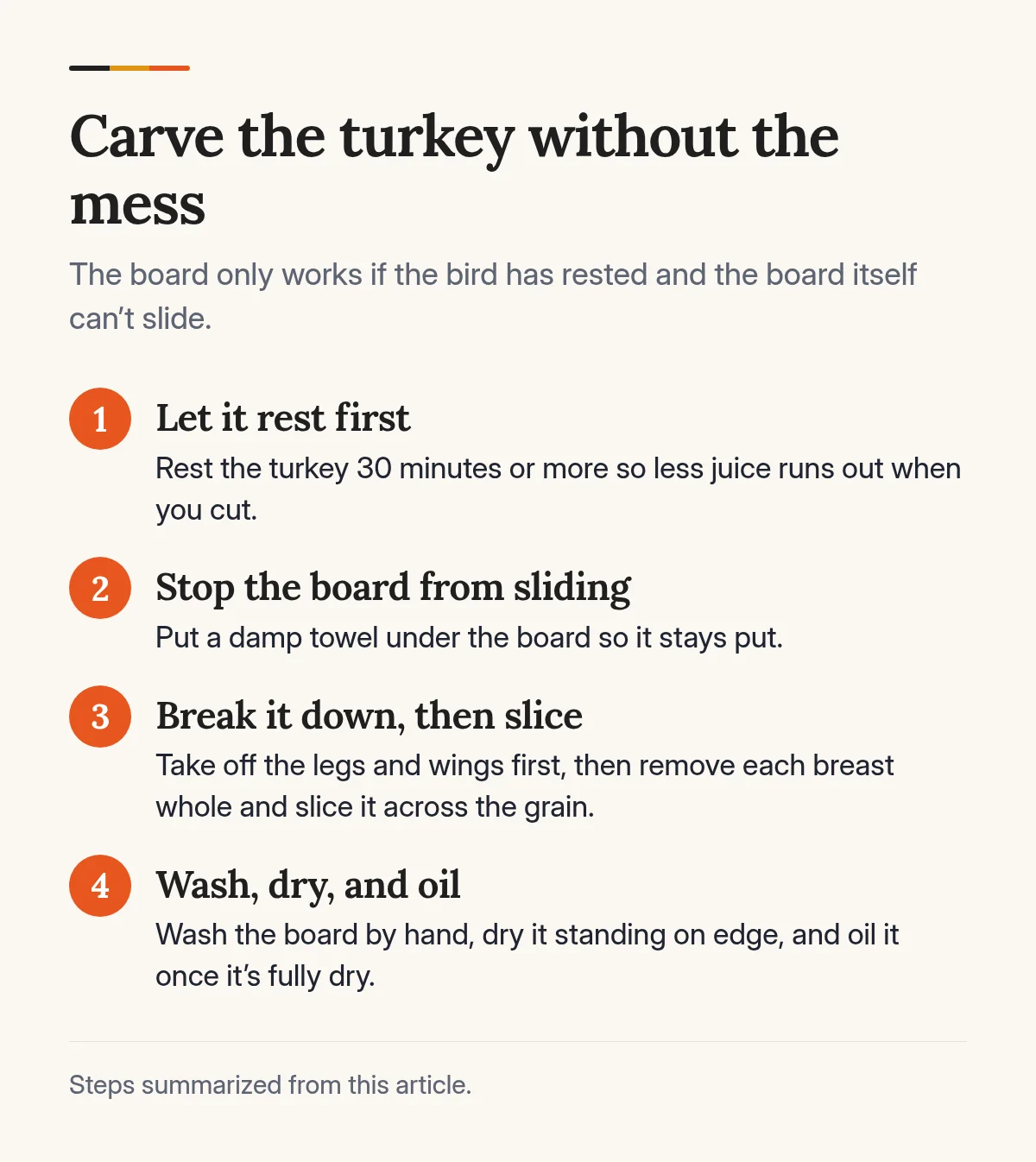
Let the turkey rest 30 minutes or more so less juice runs out when you cut. Put a damp towel under the board so it can't slide. Take off the legs and wings first, then remove each breast whole and slice it across the grain. A long slicing knife or electric knife makes neat slices; check doneness first with an instant-read thermometer. Afterward, wash the board by hand, dry it standing on edge, and oil it once it's fully dry.
Skip it if…
J.K. Adams Reversible
- You want your carving board to be your daily chopping board.
- You regularly carve whole briskets or two birds at once.
Teakhaus XL
- You can't lift about 14 lb into your sink.
- You have a small counter or nowhere to store a 24 x 18 board.
Still need the pan? See the best roasting pan for a 20 lb turkey. Choosing an everyday board? Read wood vs plastic vs composite cutting boards.
Related guides
- Is a Knife Block Set Worth It? Buy 3 Knives Instead
- Wüsthof vs Victorinox: Is a German Chef's Knife Worth 3x the Price?
- Electric vs Whetstone Knife Sharpener: Is the Chef'sChoice Trizor Worth It?
More in Knives & Boards