
Fat Separator: Bottom‑Release or Spout?
Is a fat separator worth it for Thanksgiving gravy? Bottom-release vs. spout, the plastic heat limit nobody mentions, and the free trick if you'd rather skip one.
As an Amazon Associate I earn from qualifying purchases.
In this guide
"This greasy layer on top no matter how much I whisk it."
That's one home cook on r/KitchenPro, describing every roast and turkey gravy they make. They spoon the fat off by hand. It doesn't work. They wanted to know if a fat separator is "actually useful or just another kitchen gadget that sits in a cabinet forever."1
Fair question. Here's the short version, five days before Thanksgiving.
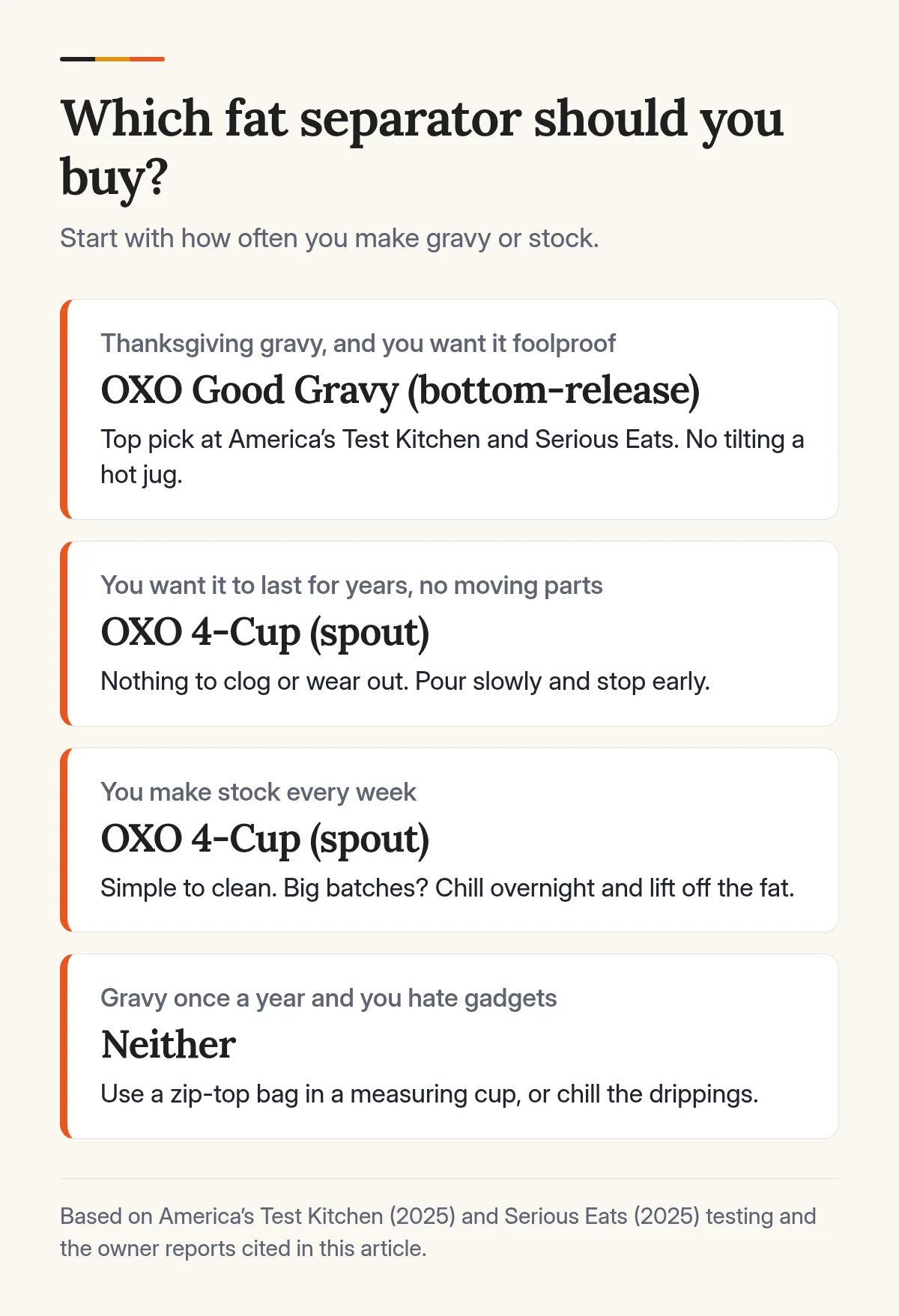
Yes, it works. That's not the question
Fat floats. A separator just gives it a few minutes to float, then lets you take the juices from underneath.
Owners agree it works. The real question is how often you'll use it. One r/KitchenPro reply nails it: worth it "if you make gravy more than one time a year," or if you host a big gathering where "people are gonna judge you." Otherwise "it just sits with the other 'party' tools gathering dust all year." Their verdict: "I still love mine."2
Bottom-release vs. spout
There are two kinds.
- Spout (pitcher) style: a jug with a spout that starts near the bottom. You tilt and pour. The fat stays on top, at least until the end.
- Bottom-release: a hole in the bottom with a plug. Squeeze a trigger in the handle and the juices drain straight down. No tilting.
America's Test Kitchen preferred bottom-release models. With pitchers, "some fat usually entered their pour spouts from the get-go," and the last quarter cup was hard to save. Serious Eats found the same thing: not tilting a full jug of hot liquid was "safer, steadier, and more accurate."
Owners say it too. One r/Cooking member doesn't like spout separators: "Nine times out of ten I end up pouring the fat over the top as well."3 An Amazon reviewer loves that the OXO "drains from the bottom, no more pulling the plug and praying you don't get burned!"4
Plot twist: the winner has a weak spot
A valve is a moving part. Moving parts fail.
One YouTube commenter went through two Cuisipro bottom-release separators. Both "eventually started to leak" because the plug stopped sealing. Now they buy spout models: "No moving parts means no leaking."5 An r/Canning member who makes stock often uses the OXO 4-cup spout model and says they've "had bad luck with the bottom drain ones."6
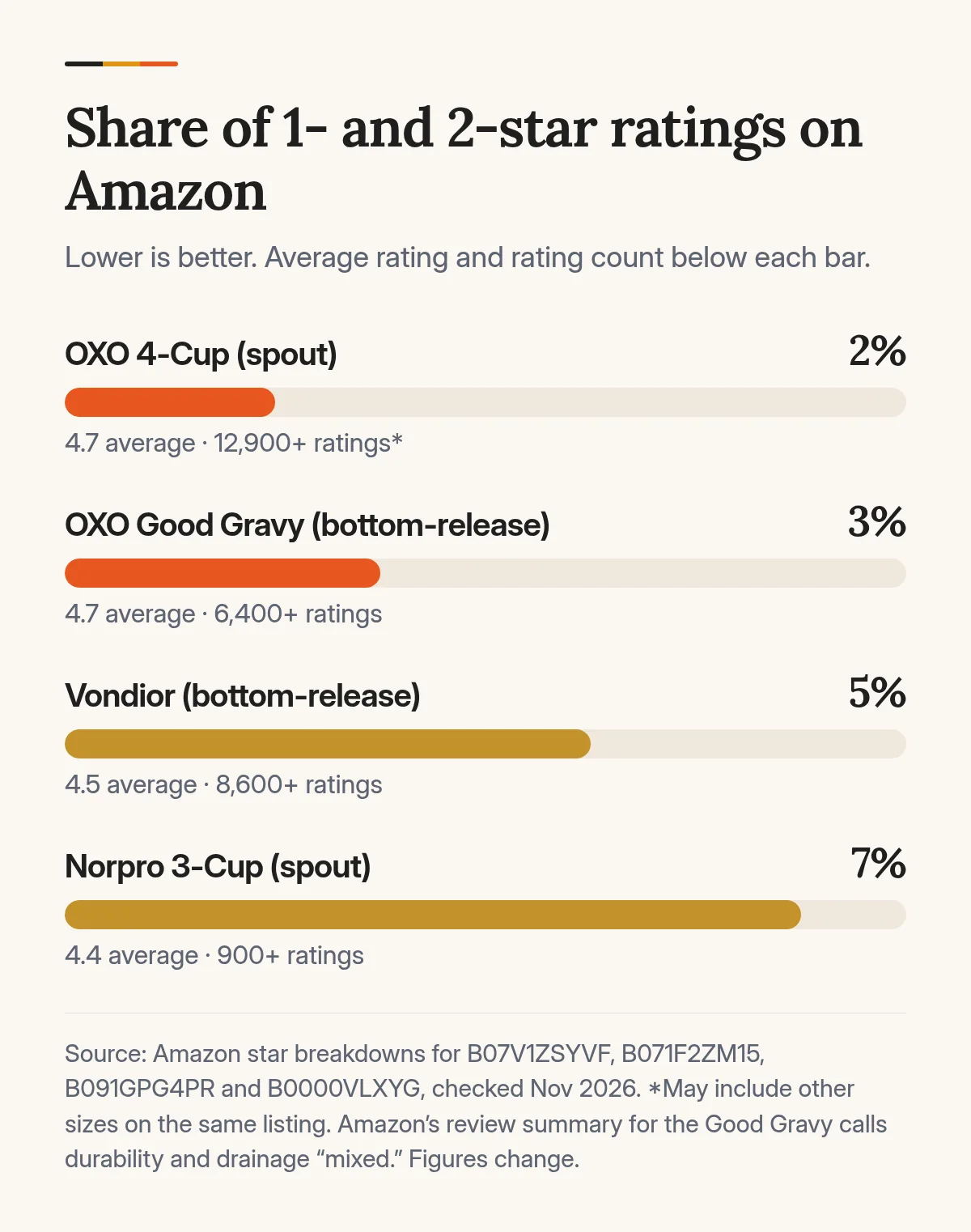
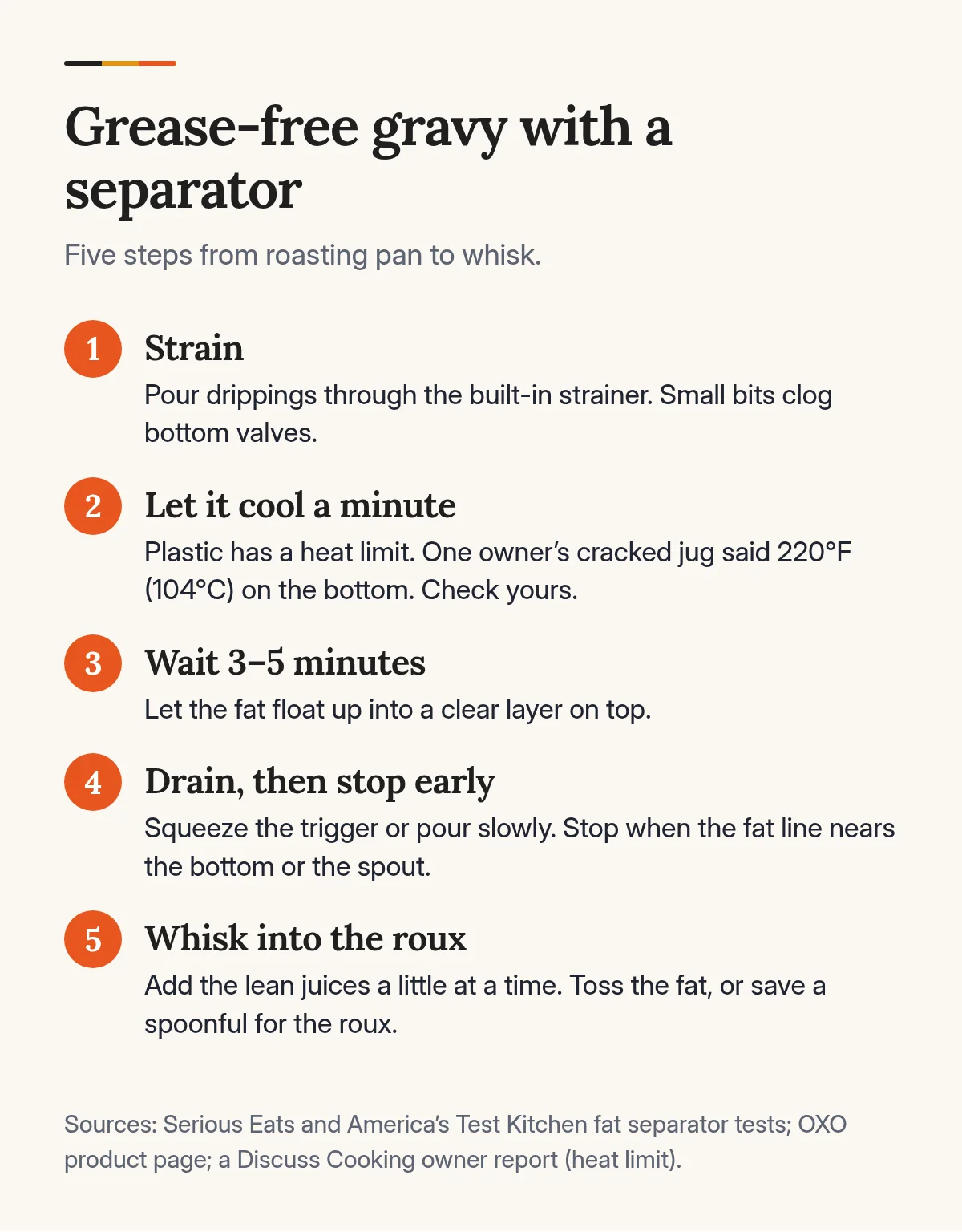
The OXO valve is the best of the bunch. ATK opened and closed it 150 times and ran it through the dishwasher 10 times with no leaks. Its one complaint: it needs a strong squeeze. Still, Amazon's review summary calls its durability and drainage "mixed." One unhappy buyer says the "valve will not let anything run through."7 Usually that's a clog. Bits of onion or herbs block the small hole, so always use the strainer.
Even Serious Eats, which picked the OXO, says any separator with moving parts "will likely have a shorter lifespan." So it comes down to what you want more. Easy to use, or built to last?
The heat limit nobody mentions
Most separators are plastic. Plastic has a limit.
On the Discuss Cooking forum, one owner poured broth straight from a pressure cooker into a plastic separator. It cracked. Then they read the fine print on the bottom: don't go above 220°F (104°C). Another member says they've "gone through 3 or 4 plastic gravy separators."8
Roasting-pan drippings can be close to that. So let them cool for a minute or two first. You'll need to wait for the fat to rise anyway. Check the bottom of yours for a temperature rating.
Want glass? Glass separators exist, but they're less common, heavier and breakable. We'd rather get the test-kitchen winner and wait one minute.
Side by side
| OXO Good Gravy | OXO 4-Cup | |
|---|---|---|
| Style | Bottom-release trigger | Spout pitcher |
| Capacity | 4 cups | 4 cups |
| Strainer | Built in | Built in |
| Moving parts | Valve | None |
| Test-kitchen pick | ATK and Serious Eats winner | Serious Eats: best spout style |
| Amazon rating* | 4.7 (6,400+) | 4.7 (12,900+) |
*When we checked. Specs from OXO and the Amazon listings. Check current prices at the retailer.
Don't want another gadget?
You have two free options.
- The zip-top bag trick: set a bag in a 2-cup measure, pour in the drippings and wait about 10 minutes. Snip a bottom corner and let the juices run out. Stop before the fat gets there. It was shared in the same Discuss Cooking thread.8
- Chill it: if you made stock ahead of time, refrigerate it overnight and lift off the hard fat. ATK does this too.
Neither works well on Thanksgiving afternoon while the turkey rests. That's the 20 minutes a separator is for.
Skip it if…
OXO Good Gravy
- You won't strain your drippings.
- Weak grip: the trigger takes a firm squeeze.
OXO 4-Cup spout
- You tend to rush the last pour.
- You often defat small amounts. The last bit is hard to pour clean.
Who makes them
OXO belongs to Helen of Troy. Its 2025 annual report says all its products are made by outside manufacturers, mostly in Asia and "principally in China." For a plastic jug, the details matter more than the city: a big strainer, clear markings, a tight valve and a heat-resistant body. OXO says it uses nylon and Tritan.
Finishing your Thanksgiving gear list? You'll need a roasting pan big enough for the bird, an instant-read thermometer and a carving board with a deep groove. Then make the mashed potatoes worth pouring this gravy on.
Owner stories are quoted from public posts and lightly trimmed. They are other people's experiences, not our own testing.
- “Gravy always greasy, is a fat separator actually useful,” May 2026, r/KitchenPro
- An owner's comment, May 2026, r/KitchenPro
- A comment, Dec 2024, “Gravy fat separator,” r/Cooking
- An Amazon review of the OXO Good Gravy Fat Separator
- A comment on America's Test Kitchen's fat separator video, YouTube
- A comment, Mar 2021, “Fat separator recommendations?” r/Canning
- An Amazon review of the OXO Good Gravy Fat Separator
- “Help Please...gravy separator,” 2007, Discuss Cooking forum
Related guides
- Best Container to Brine a Turkey: Bag, Bucket or Cooler?
- Is MEATER Worth It? Why It Can Ruin Your Turkey
- Potato Ricer vs Masher: Which Tool for Thanksgiving Mashed Potatoes?
More in Drinkware & Small Tools