
Best Container to Brine a Turkey: Bag, Bucket or Cooler?
Brine bags pop and leak. The container that fits a 20-lb turkey, how to brine in a cooler when the fridge is full, and when to skip the wet brine.
As an Amazon Associate I earn from qualifying purchases.
In this guide
A loud pop. Then turkey brine on the floor, the walls, the counter and inside the open pot cabinet.
That's how one first-time briner on r/tifu describes lifting a bagged turkey out of a stockpot. He cleaned up, re-bagged the bird and put it back in the fridge. The next morning the bag's seal had failed overnight. Brine all over the fridge. "The turkey was damn good," he admits. But it cost him about three extra hours.1
The top reply: "Brining bucket my friend. Way easier to use, clean and store."1
He's mostly right. Here's the short version.
The bag is the weak link
Brine bags are cheap and they save brine. They also fail in the same few ways.
An r/smoking member who'd brined about four turkeys in bags wanted to stop: "I always have a pretty bad experience with them."2 On The Virtual Weber Bulletin Board, one cook bought grocery-store turkey bags so thin they "sprang a leak with a small chicken." Another says 9 out of 10 of their Hefty zip bags "haven't sealed well."3
The fix is simple. Put the bag inside something rigid. One r/Cooking member seals the bird in a bag, then sets it in the roasting pan "as an extra layer of leak protection."4
And use a food-grade bag. USDA says don't use a household trash bag.
Fridge room? Get a real container
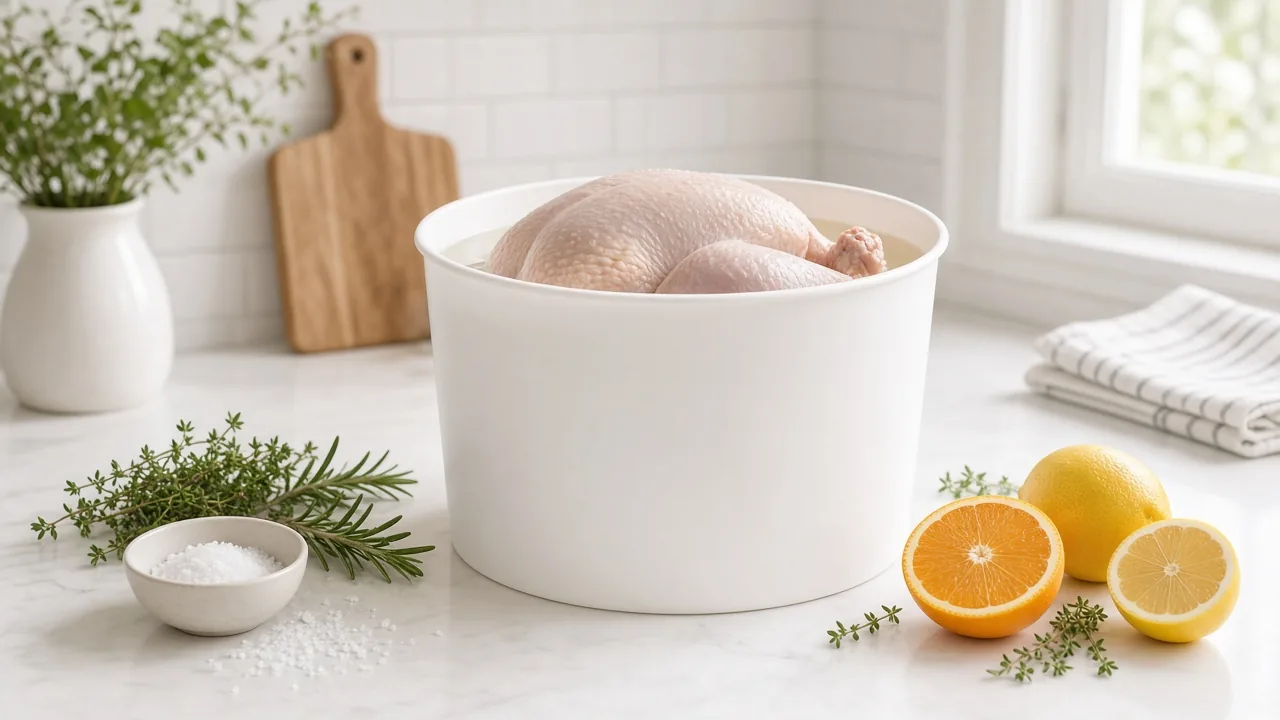
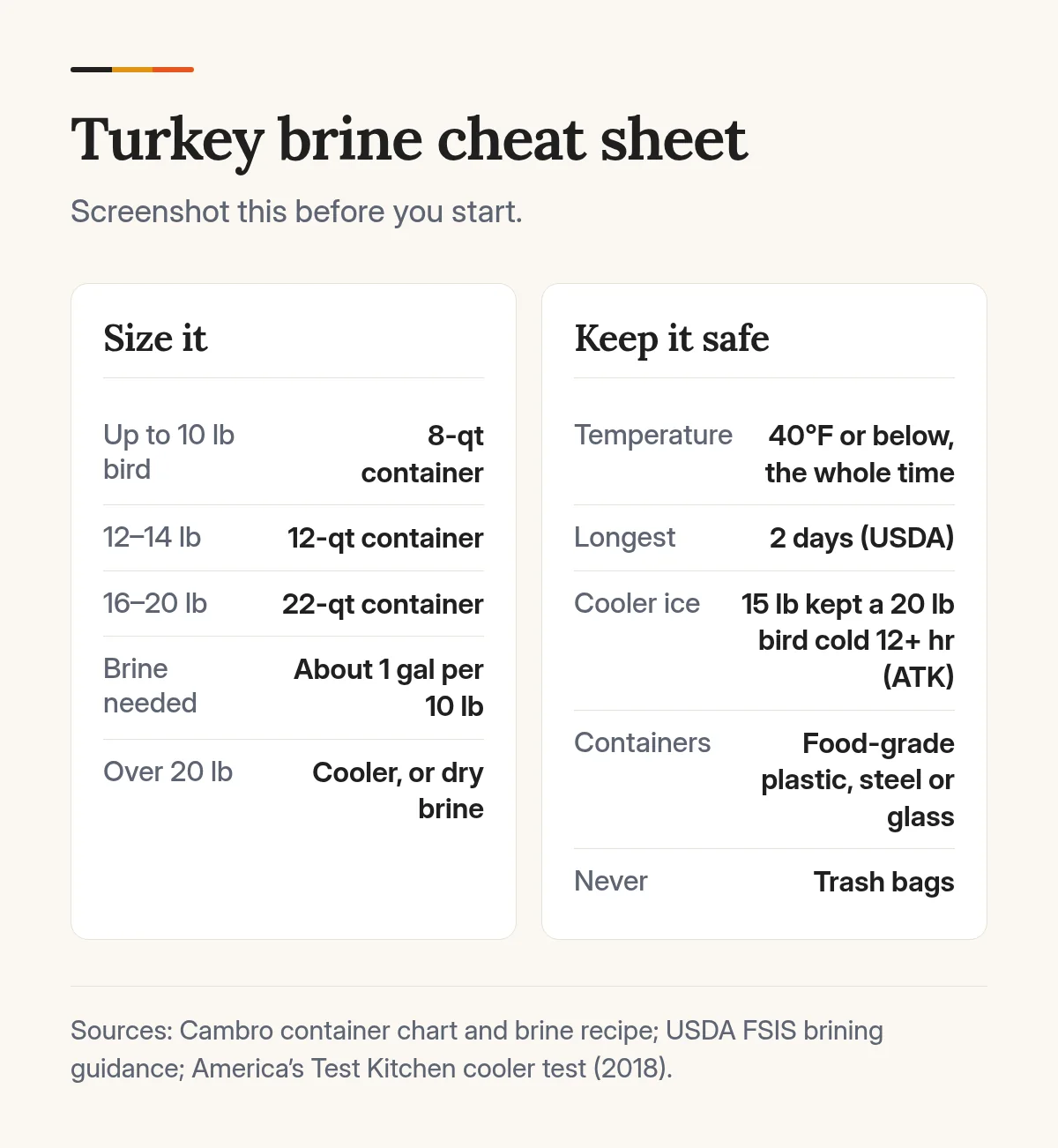
USDA says to brine in food-grade plastic, stainless steel or glass, with a lid, at 40°F or below. A restaurant food container checks every box.
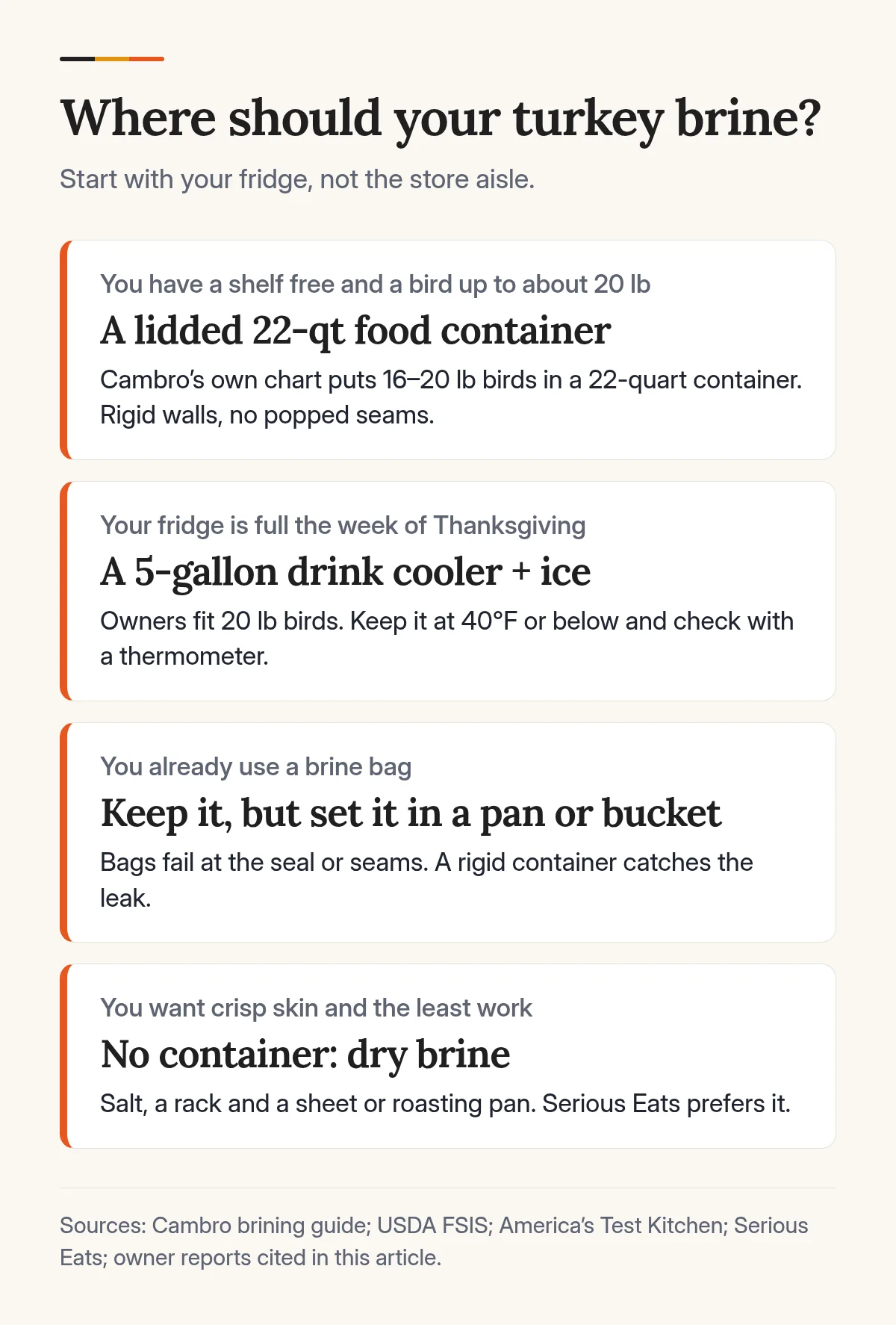
Our pick is the Cambro 22-quart FreshPro with lid. Cambro's brining guide puts 16–20 lb birds in a 22-quart container and 12–14 lb birds in a 12-quart. It has molded handles, it's see-through, and it's made for food, not paint.
An r/thanksgiving member does the same thing with an 18-quart container "from the Restaurant Store."5 On Amazon, one Cambro buyer calls it "great size for a turkey." Another said it fit in the fridge, but "even half full, it's heavy."6
The catch: it's 16 inches tall. Measure your shelf before you order. And the lid is a snap-on seal cover, not a screw top. Keep it upright.
Is a hardware-store bucket OK?
Lots of people use one. One r/Cooking member uses an empty 5-gallon bucket from the hardware store's paint section, washed out and lined with a heavy plastic bag.7
It's not our first choice. USDA's rule is food-grade plastic. Some buckets are sold as food-safe and some aren't, so read the label. If it doesn't say, put a food-grade bag inside.
One more thing. A bucket isn't insulated. On a TVWBB thread, a member notes that a 5-gallon bucket works for a whole turkey, but pieces float "and then you need weights or plates to hold them down."8 A zip bag of ice on top works.
Fridge full? The cooler trick
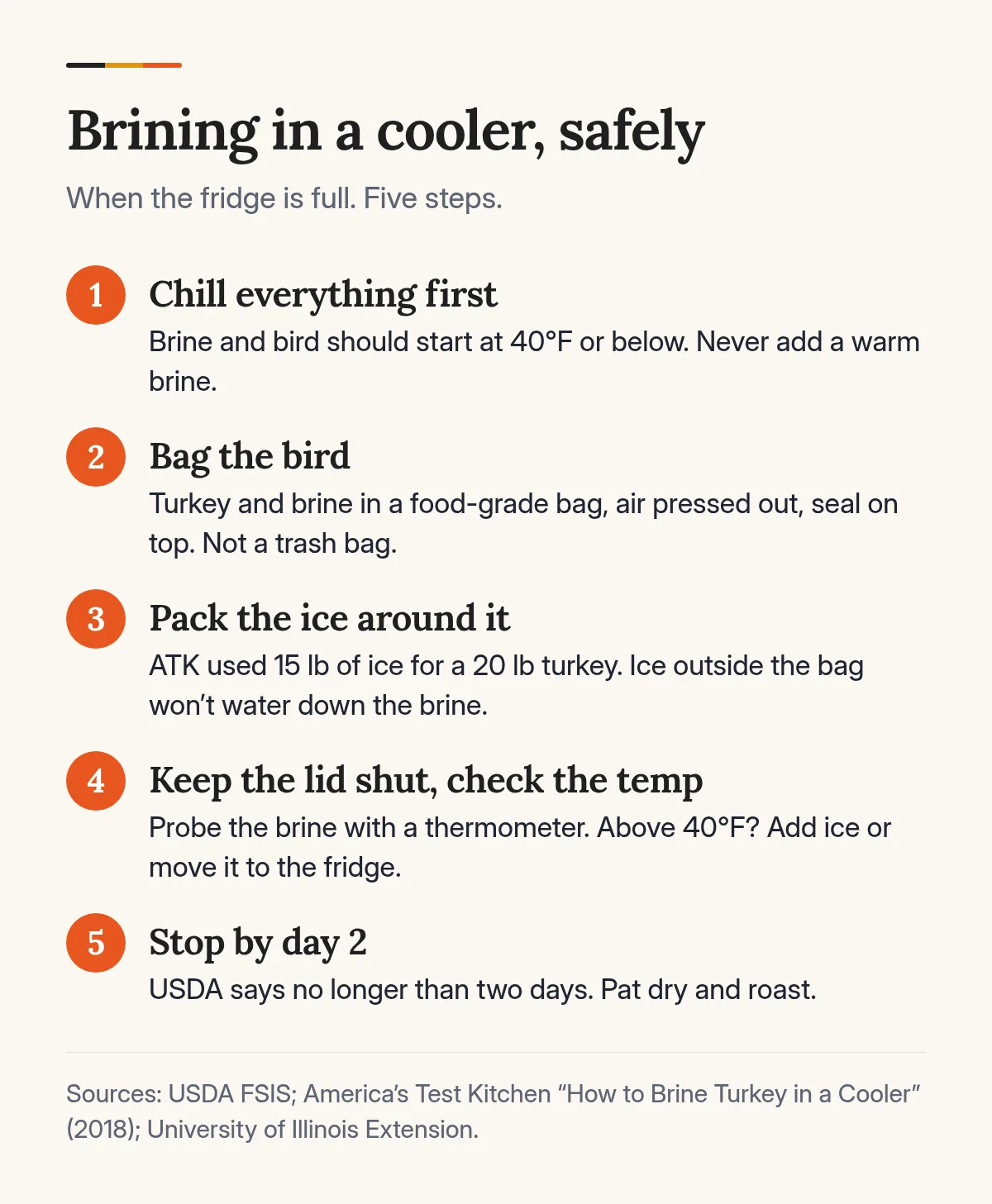
This is the big one the week of Thanksgiving. USDA says a cooler with ice is fine, as long as everything stays at 40°F or below.
America's Test Kitchen tested it. The turkey and brine went into a sealed bag, then into a cooler with 15 pounds of ice. That kept a 20-pound turkey cool for more than 12 hours.
The cooler owners love most is the round sideline drink jug. An r/smoking member: "Turkey fits perfectly and doesn't allow the brining bag to spread."2 On TVWBB, one cook brines a 24-pound turkey in a square 5-gallon water cooler.8 The spigot makes draining easy.
A cheap chest cooler works too. Another r/smoking member poured in two bags of ice and says it "lasted for 24hrs, no fridge required."2
Don't count on the garage
Here's the mistake. People think a cold garage or porch counts as a fridge.
When an r/Cooking member asked about a 60-degree week, the reply was blunt: "Your garage will not stay <40 if the weather outside is in the 60s." Another said insulation is "really the key factor." They wrap an iced bucket in towels, and say it stays in the safe zone for 18 to 24 hours.9
Styrofoam can also leak. An r/thanksgiving member found out their foam cooler was "not water-tight" before the turkey went in.5 Fill it with water a day early to check.
Whatever you use, stick an instant-read thermometer in the brine now and then. Above 40°F? Add ice.
Plot twist: skip the bucket
The cheapest container is no container.
Serious Eats' turkey brining guide puts it plainly: "I vastly prefer dry brining." A wet brine adds mostly water, so the meat can taste "watered down." A dry brine keeps the bird's own juices, and the drier skin browns better.
All you do is salt the turkey, set it on a rack in a rimmed pan and refrigerate it uncovered for 12 to 24 hours. A roasting pan with a rack or a half sheet pan with a wire rack is all you need. You'll want the roasting pan on Thursday anyway.
Two of the r/Cooking replies to that 60-degree question start the same way: "I dry brine" and "These days I dry brine."9
Love a classic wet brine? Fine. Just don't buy a bucket because you think you have to.
Side by side
| Fridge space | Leak risk | Cleanup | |
|---|---|---|---|
| Bag alone | Low | High | Toss it |
| Bag in pan or bucket | Medium | Low | Easy |
| 22-qt Cambro | Tall shelf | Low | Dishwasher safe |
| Drink cooler + ice | None | Low | Wash and sanitize |
| Dry brine | One shelf | None | Rack and pan |
Based on the sources in this article. Check current prices at the retailer.
Skip it if…
Cambro 22-qt
- Your fridge shelves can't fit 16 inches.
- Your bird is over 20 lb.
Igloo 5-gallon
- You won't check the temperature.
- You don't want to wash and sanitize a drink cooler after raw poultry. Use a bag inside.
Where they're made
Both picks come from long-time US manufacturing hubs. Cambro was founded in Los Angeles in 1951. It says 99% of the products it sells in North America are made in its US factories in California and North Carolina, and most of its food-contact items are NSF-listed. Igloo is based in Katy, Texas and marks 75 years of US manufacturing. Its comparison chart on the Amazon listing marks this 5-gallon jug Made in USA.
Next up on your Thanksgiving list: a leave-in thermometer you can trust, a fat separator for the gravy and a carving board with a deep groove.
Owner stories are quoted from public posts and lightly trimmed. They are other people's experiences, not our own testing.
- “TIFU by attempting to brine my turkey for the first time,” and its top reply, Nov 2021, r/tifu
- “Brining turkey in a cooler,” post and comments, 2022–2025, r/smoking
- “Best Brining bags?” 2016, The Virtual Weber Bulletin Board
- A comment, Nov 2020, “What do you brine a turkey in?” r/Cooking
- “Wet brining question,” post and a comment, Nov 2022, r/thanksgiving
- Customer reviews quoted on the Cambro FreshPro 22-quart Amazon listing
- A comment, Nov 2012, “Best Container for Brining?” r/Cooking
- “Insulated Brining Bucket?” 2024, The Virtual Weber Bulletin Board
- Comments, Nov 2022, “To those who brine: What is your method/set up?” r/Cooking
Related guides
- Fat Separator: Bottom-Release or Spout?
- Is MEATER Worth It? Why It Can Ruin Your Turkey
- Potato Ricer vs Masher: Which Tool for Thanksgiving Mashed Potatoes?
More in Drinkware & Small Tools