
Wüsthof vs Victorinox: Is a German Chef's Knife Worth 3x the Price?
A dull, slippery knife makes holiday prep slow and unsafe. Test kitchens split between the light Victorinox Fibrox Pro and the heavy Wüsthof Classic. Here's which 8-inch chef's knife to buy, and how to spot a 'German' knife that isn't.
As an Amazon Associate I earn from qualifying purchases.
In this guide
The short version
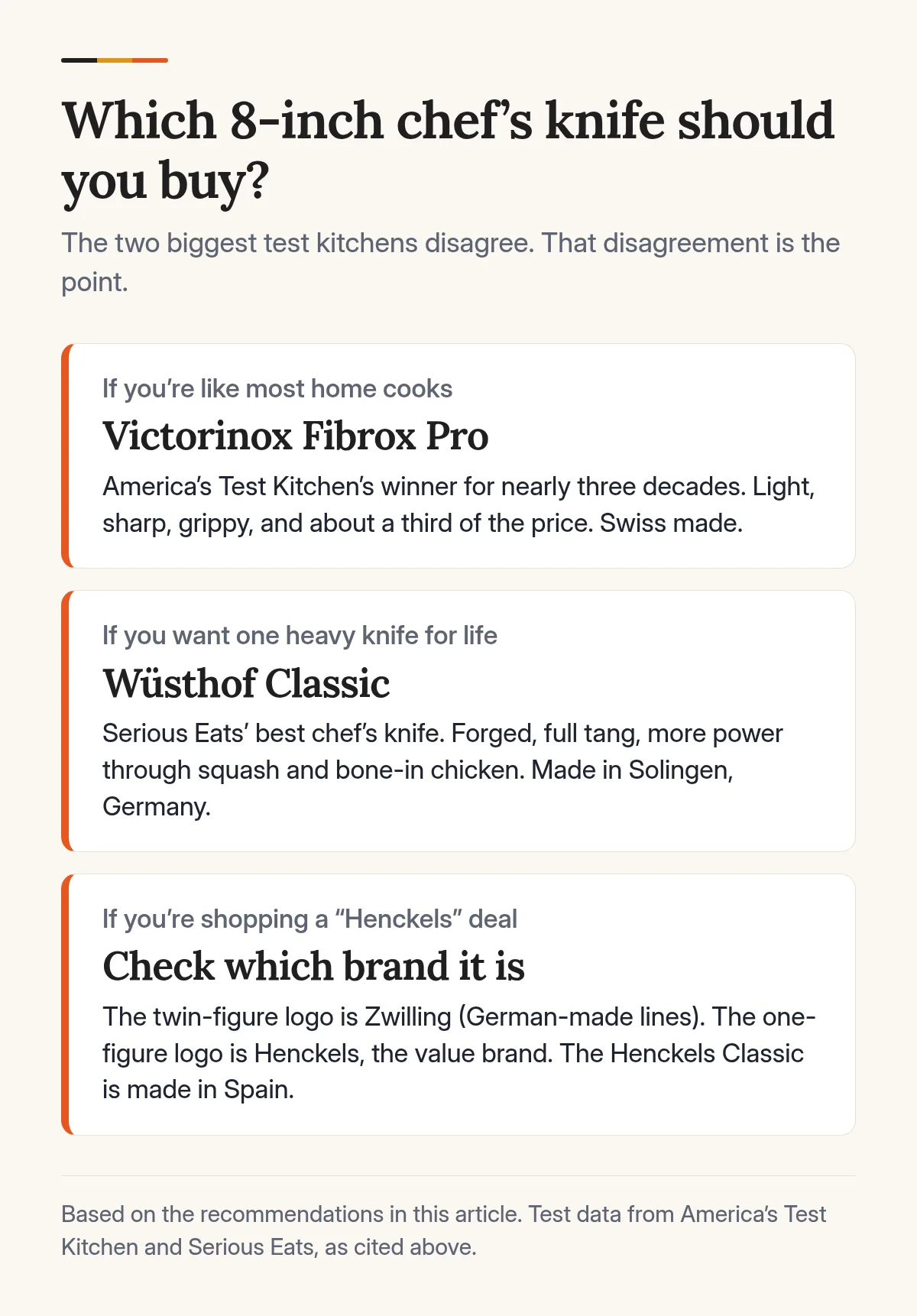
- Most home cooks → Victorinox Fibrox Pro 8-inch. America's Test Kitchen's winner for nearly three decades. Light, sharp, grippy, and about a third of the price. Swiss made.
- You want one heavy knife for life → Wüsthof Classic 8-inch. Serious Eats' best chef's knife. Forged, full tang, more power through squash and bone-in chicken. Made in Solingen, Germany.
- Shopping a "Henckels" deal? Check the logo. Two little men (Zwilling) are German-made lines; one man (Henckels) is the value brand. The Henckels Classic is made in Spain.
The real problem: a knife that slips, crushes and wears you out
Holiday prep means a mountain of onions, celery, squash and a turkey to break down. A dull or badly balanced knife crushes tomatoes instead of slicing them, slides off onion skin, and makes your wrist ache by the third bag of potatoes. That's also when most cuts happen.
The question buyers keep asking on r/chefknives is simple: is a roughly $170 Wüsthof really better than a Victorinox that costs about a third as much? The honest answer is that the two biggest test kitchens disagree, and the reason they disagree tells you which one to buy.
Victorinox Fibrox Pro vs Wüsthof Classic
| Victorinox Fibrox Pro 8" | Wüsthof Classic 8" | |
|---|---|---|
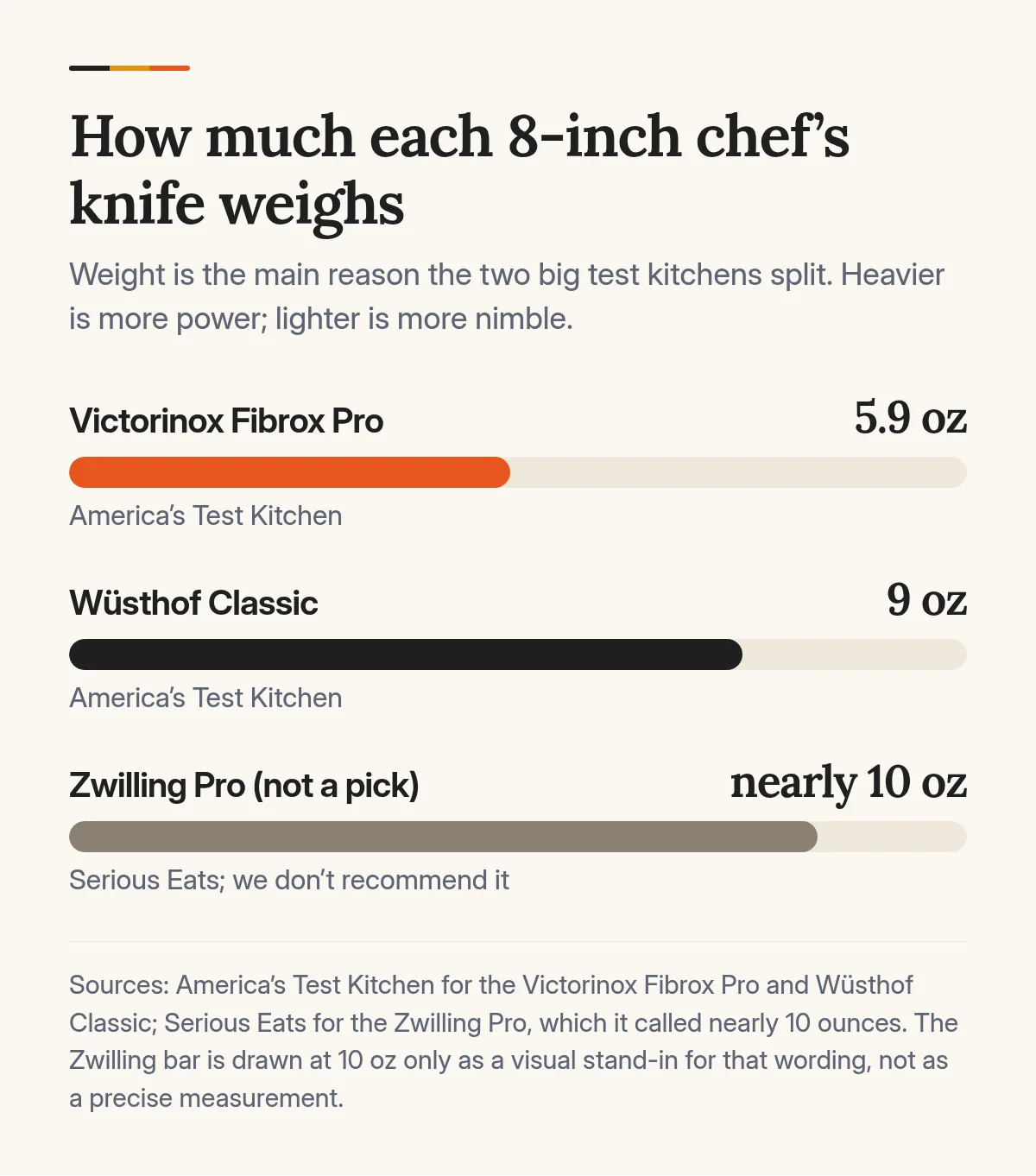
| Weight (ATK) | 5.9 oz | 9 oz |
| Edge angle (ATK) | 15° | 14° |
| How it's made | Stamped, thin blade | Forged, full bolster, full tang |
| Hardness | Not stated by Victorinox | 58 HRC (Wüsthof) |
| Handle | Textured non-slip TPE | Triple-riveted synthetic |
| America's Test Kitchen | Winner | Tested; "a little less nimble" |
| Serious Eats | A Victorinox 8" was not recommended | Best chef's knife |
| Published origin | Switzerland | Solingen, Germany |
| Price tier | $ | $$$ |
Test data from America's Test Kitchen and Serious Eats. Specs from Wüsthof and the Victorinox listing. Check current prices at the retailer.
Why the Victorinox wins for most people
ATK says it has "routinely tested and recommended" the Victorinox Fibrox Pro 8-inch for nearly three decades, and it won again in ATK's 2026 review. Testers said it minced garlic precisely and broke down chicken and dense butternut squash "with authority." At under 6 ounces it's easy to use for an hour of prep, and its textured handle stays secure when wet, for big and small hands alike.
The trade-off is softer steel: it needs honing and sharpening more often, and it looks plain. Serious Eats didn't recommend the Victorinox 8-inch it tested, saying its wide handle felt uncomfortable and it struggled with tomato skin. If you have small hands, hold one first. For most kitchens, though, it's the knife to buy, and the money you save buys a good sharpener and cutting board.
When the Wüsthof is worth it
Serious Eats calls the Wüsthof Classic 8-inch its longtime favorite, and it "sliced its way to victory yet again" in its latest tests: its heft "easily glided through produce and protein." ATK agreed it provides "more power than many of the other knives" and was quite sharp, but found the thick spine and weight made it "a little less nimble."
So the Wüsthof is for cooks who like a heavy knife doing the work: splitting squash, cutting through chicken joints, rock-chopping herbs. It's forged from one piece of steel with a full tang, and Wüsthof backs it with a lifetime warranty. It's also a gift people keep for decades. If you prefer a light, quick knife, the extra weight is a cost, not a feature.
Zwilling or Henckels? Check the logo
Zwilling J.A. Henckels sells two brands. Knives with the twin-figure logo are Zwilling; the one-figure logo is Henckels, the value brand. Many listings say "German engineered" or "German steel," which is not the same as made in Germany.
- Henckels Classic 8-inch: Henckels' own product page lists the country of origin as Spain.
- Zwilling Pro 8-inch: Zwilling's product page lists Germany. But Serious Eats found it sharp yet heavy, at nearly 10 ounces, with a wide blade that was awkward to lift over food, so it isn't one of our picks.
Neither origin makes a knife bad on its own; ATK included the Spain-made Henckels Classic in its tests. Just know what you're paying for.
Where they're made
- Victorinox. The company started as a cutler's workshop in Ibach, Switzerland, in 1884, and its Amazon listing states "Swiss Made: Yes."
- Wüsthof. Family-owned for seven generations in Solingen, Germany. Wüsthof lists the Classic's country of origin as Germany.
Keep any chef's knife sharp longer
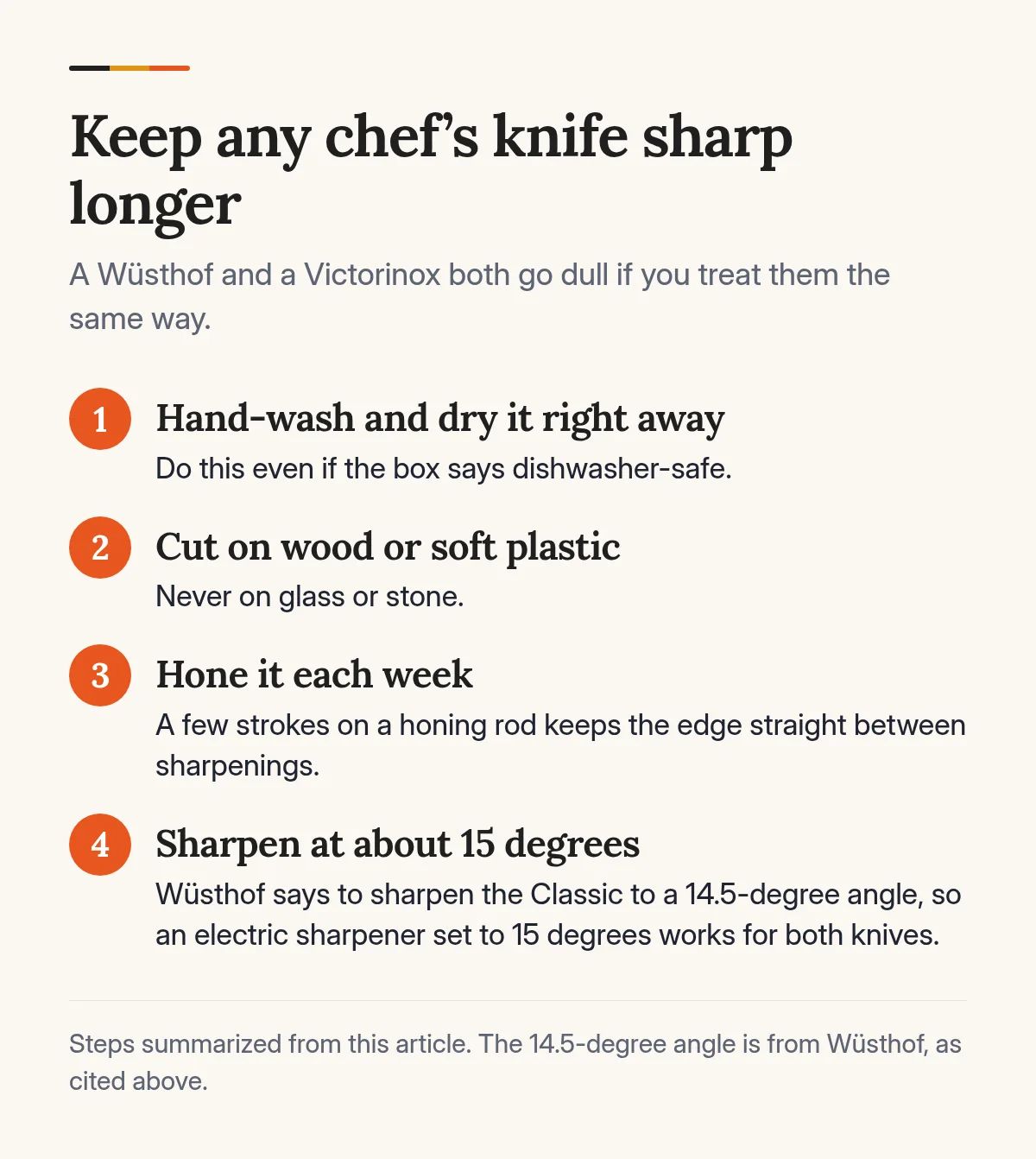
Hand-wash and dry it right away, even if the box says dishwasher-safe. Cut on wood or soft plastic, never glass or stone. A few strokes on a honing rod each week keeps the edge straight between sharpenings. Wüsthof says to sharpen the Classic to a 14.5-degree angle, so an electric sharpener set to 15 degrees works for both knives.
Tempted by a Black Friday block set instead? Read whether a knife block set is worth it first. Most of the pieces are filler.
Skip it if…
Victorinox Fibrox Pro
- You want a knife that looks good on display.
- You won't hone or sharpen it at least a few times a year.
Wüsthof Classic
- You prefer a light, fast knife.
- You have small hands or wrist pain.
Carving the turkey? See electric knife vs carving knife. Still deciding between German and Japanese styles? Read how to choose a chef's knife.
Related guides
- Is a Knife Block Set Worth It? Buy 3 Knives Instead
- Best Carving Board for Turkey: J.K. Adams vs Teakhaus (Do You Need a Juice Groove?)
- Electric vs Whetstone Knife Sharpener: Is the Chef'sChoice Trizor Worth It?
More in Knives & Boards