
Is HexClad Worth It? Hybrid vs. Nonstick vs. Stainless
HexClad is tougher than plain nonstick but less slick, and test kitchens noticed. Who should buy a hybrid pan, and who should get a cheap nonstick or stainless instead.
As an Amazon Associate I earn from qualifying purchases.
In this guide
The ad promised eggs that slide. The photo showed a pan full of glue.
One r/cookware user posted a picture of a HexClad skillet with a thin layer of scrambled egg welded across the hexagons, and a one-line caption: "How do you charge $130 for a premium nonstick pan to get these kinds of results consistently?" It got more than 1,500 upvotes.1
Scroll down, though, and the replies split. One owner said they've used HexClad pans daily for two years with "no problems at all," and that the photo looked like "not enough oil/butter and too high of heat."2 Both can be true. Here's why, and which pan you should actually buy this Black Friday.
What a hybrid pan actually is
A HexClad is a tri-ply stainless pan with a grid of laser-etched steel hexagons on the cooking surface. The low "valleys" between them hold a nonstick coating. Today HexClad calls it TerraBond, a ceramic nonstick it says is free of PTFE. The idea: the steel peaks sear, the coating releases, and metal spatulas ride on the steel instead of scraping the coating.
The catch is right there in the design. Every hexagon is a little patch of bare stainless steel. And stainless sticks.
The test kitchens weren't impressed
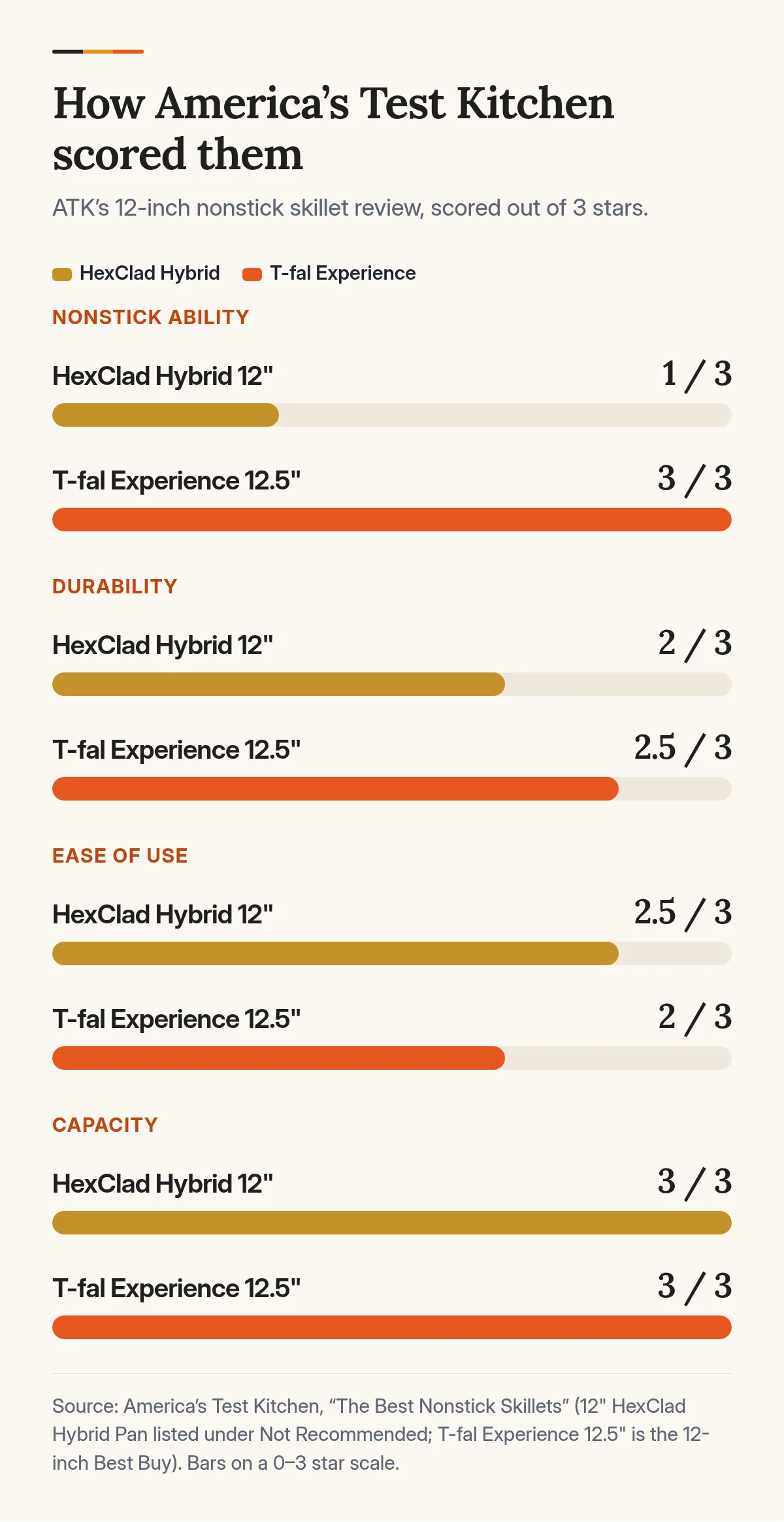
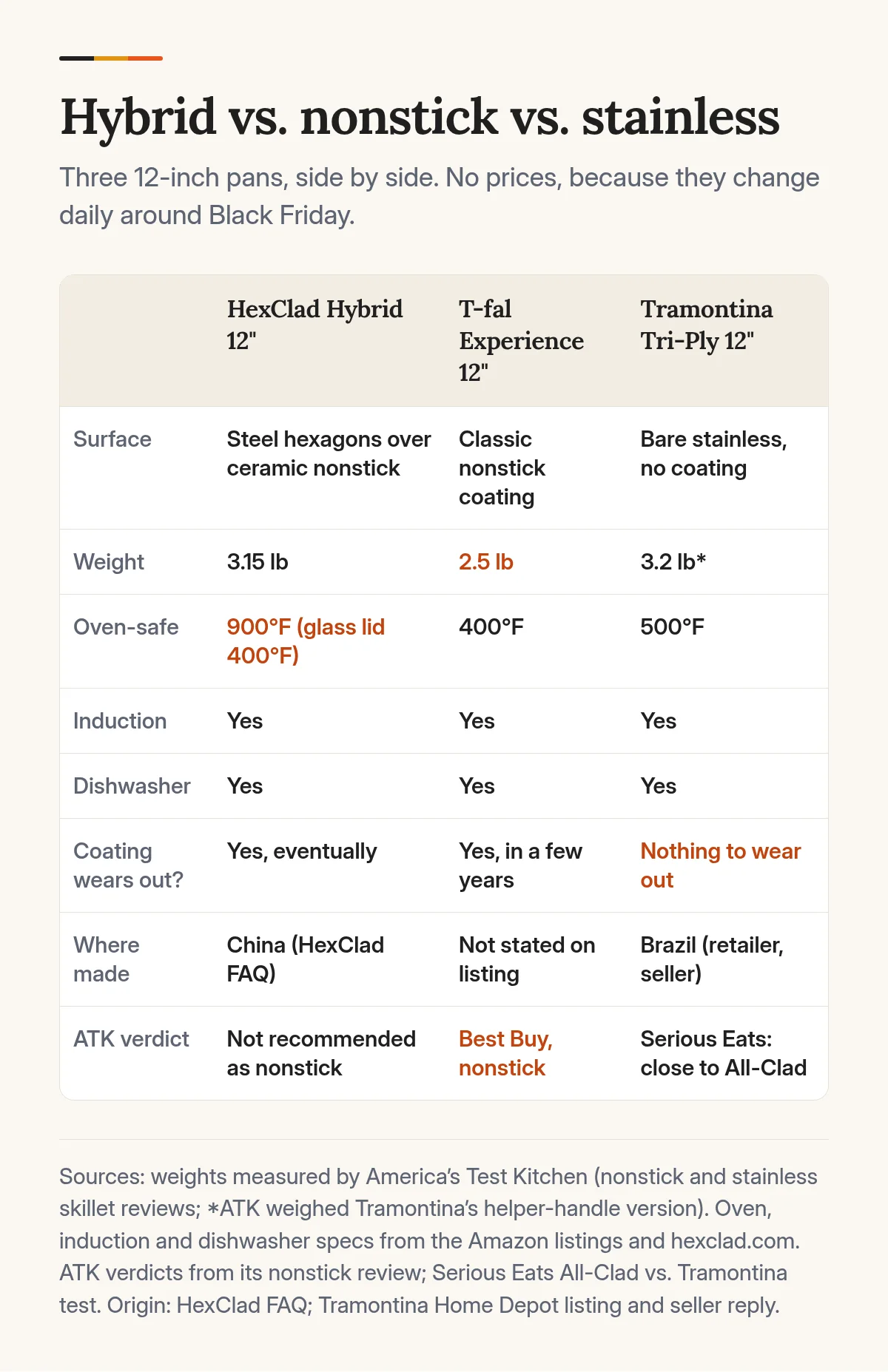
America's Test Kitchen put the 12-inch HexClad in its nonstick skillet review and listed it under Not Recommended. "This pan wasn't truly nonstick; eggs stuck to it," ATK wrote, and even an oiled frittata didn't slice out cleanly. It seared meat well, but the walls were short and it was heavy at 3.15 lb.
ATK's Best Buy, the T-fal Experience, scored 3 out of 3 for nonstick ability. HexClad scored 1.
Bon Appétit's reviewer was kinder about day one and harsher about year one. The pans "did okay" in testing, but the reviewer saw the same sticking on a year-ish-old HexClad set that unhappy owners describe. Her explanation, from an MIT materials scientist: ceramic coatings crack microscopically with every heat cycle. That's true of every ceramic pan, not just HexClad.
Owners love it, or bin it
The fans are real. One r/BuyItForLife owner said two HexClads became "my go-to pans for almost everything." Less slick than true nonstick, but "significantly more nonstick" than their stainless, and tougher than other nonstick pans they'd owned.3 One r/cookware user has used a HexClad set for about four years and called it "still in great condition."4
The haters are just as specific. Another r/cookware user first cooked on a friend's new HexClad: "at first it was amazing but no joke, after maybe the 5th time cooking, things would keep sticking," with food stuck in the hexagon crevices. They now cook on carbon steel.5 One r/BuyItForLife owner said theirs "started sticking like glue" despite medium heat and wooden tools, and threw it out.6
Plot twist: it wants low heat
Here's what the ads don't say out loud. HexClad's own FAQ says its pans "perform the best on low to medium heat." High heat "can cause a build up of burnt residue," and it asks you to season the pan with oil before first use.
So the pan sold as the steak-searing, do-it-all hero is happiest at the heat you'd use for eggs. The owner who reported no problems also said you only warm it "30 seconds to a minute on medium, and then turn the heat down."2 If you cook like that, a HexClad can work well for years. If you crank the burner, you'll fight it.
And the lifetime warranty? HexClad's warranty page excludes damage from "excessive heat," improper cleaning or improper seasoning. It doesn't cover worn-out nonstick.
The "non-toxic" lawsuit
HexClad's older pans used a PTFE-based coating while being marketed as "non-toxic." Buyers sued, and HexClad agreed to a $2.5 million class settlement without admitting wrongdoing. The court's final approval order permanently bars HexClad from calling any PTFE or PFAS product "PFAS free," "PFOA free" or "non-toxic." The court estimated payouts at about 2% of the purchase price. One r/cookware user reported their check: "$10 isnt it."7 The claim deadline has passed.
Current pans use the ceramic TerraBond coating instead. Our take: judge any pan on cooking, not safety marketing. For classic PTFE nonstick, ATK's rule is simple: keep it below 500°F, where it can start to give off fumes.
Hybrid vs. nonstick vs. stainless
Our picks
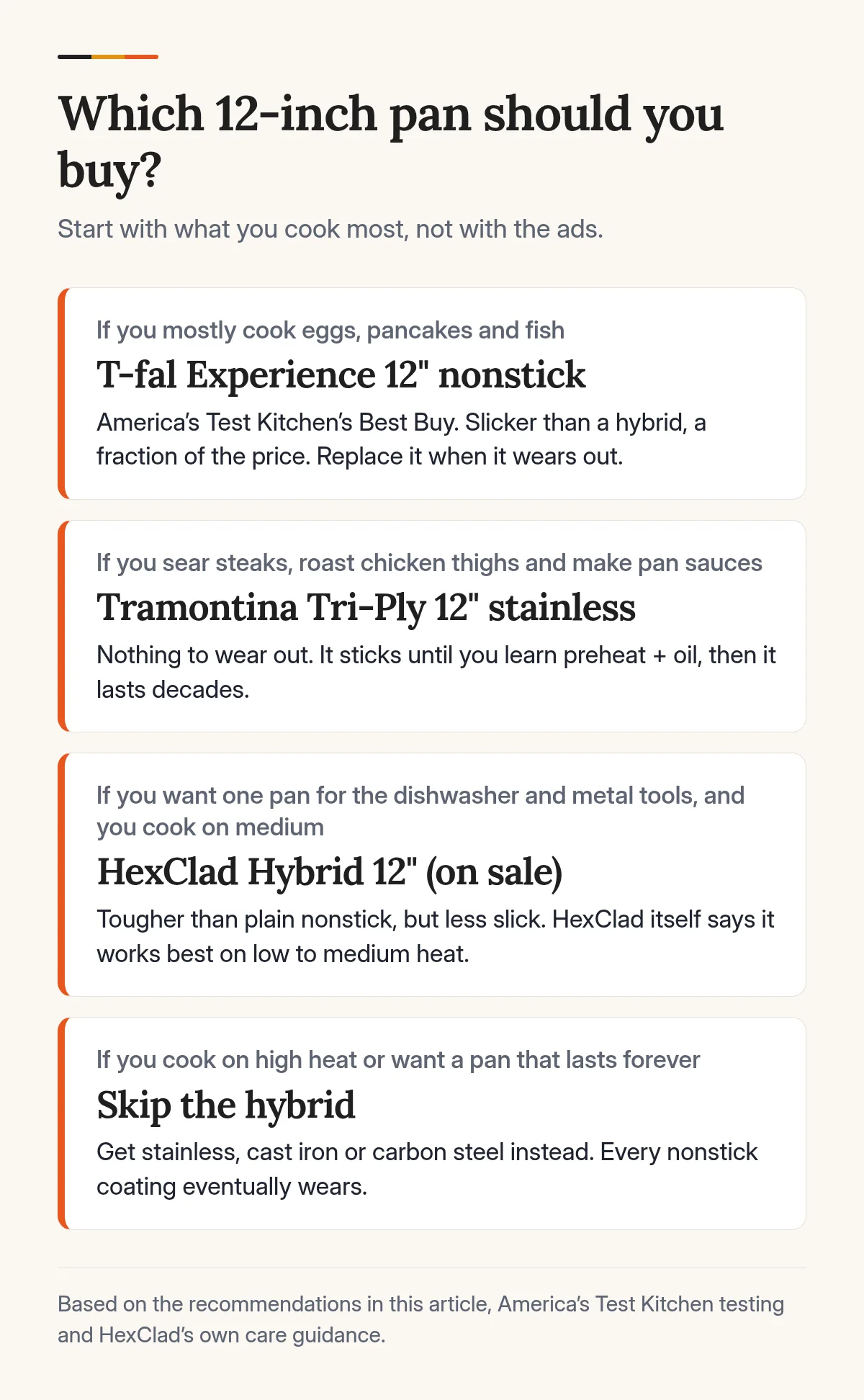
For eggs and easy dinners: T-fal Experience 12"
The T-fal Experience is ATK's Best Buy: light at 2.5 lb, slippery and induction-ready, oven-safe to 400°F. The center is slightly domed, so oil drifts to the edges. It had 4.5 stars from about 7,600 ratings when we checked. It will wear out. At this price, that's fine.
For a pan that outlives you: Tramontina Tri-Ply Clad 12"
The Tramontina Tri-Ply Clad came out nearly identical to All-Clad in Serious Eats' head-to-head. It's oven-safe to 500°F and dishwasher-safe. Preheat, add oil, wait for the shimmer, and most sticking goes away. Full details in our stainless skillet comparison.
Only if you'll cook on medium: HexClad Hybrid 12" with lid
The HexClad 12-inch comes with a glass lid and is oven-safe to 900°F (lid to 400°F). It had 4.2 stars from more than 10,000 ratings when we checked, and Amazon's review summary says feedback on the nonstick is mixed. It's often discounted from its list price, so don't pay full price.
Don't buy a HexClad if…
- Eggs are your main job. Plain nonstick is slicker and far cheaper.
- You have a glass-top stove and you slide pans. One r/cookware owner said the raised hex pattern repeats on the bottom of the pan, with sharp steel "cutting into the glass surface."8
- You lid hot pans. Another owner heard "a popping sound" two minutes after putting a HexClad glass lid on a hot wok, and found it shattered.9 One report, but use a stainless lid on high heat.
- You want "buy it for life." Get cast iron, a carbon steel wok or stainless. For braises, a Dutch oven beats any skillet.
Who makes them
HexClad says its products are designed in Los Angeles and South Korea and manufactured in China. Tramontina's tri-ply clad line is sold as made in Brazil, per a Home Depot listing and a Tramontina seller reply (check your box). The T-fal listing doesn't say where the pan is made, so we won't guess.
Owner stories are quoted from public posts and lightly trimmed. They are other people's experiences, not our own testing.
- “Hexclad is shit,” Oct 2026, r/cookware
- Reply in “Hexclad is shit,” Oct 2026, r/cookware
- Reply in “Are Hexclad Pots and pans BIFL?,” Nov 2023, r/BuyItForLife
- Another reply in “Hexclad is shit,” Oct 2026, r/cookware
- A third reply in “Hexclad is shit,” Oct 2026, r/cookware
- Reply in “Is Hexclad worth it?,” Jul 2024, r/BuyItForLife
- “Hexclad Settlement,” Jun 2026, r/cookware
- “Never Buy Hexclad Pans For a Glass-top Stove,” Aug 2026, r/cookware
- “Hexclad lid,” Aug 2026, r/cookware
Related guides
- Ninja Creami vs. Cuisinart: Which Ice Cream Maker?
- KitchenAid Pasta Attachment vs. Marcato: Worth It?
- Is Silpat Worth It Now That Its Maker Closed?
More in Cookware & Bakeware